
[ad_1]
Rabat — It costs a family over $3,000 to evacuate Gaza, per a Friday X post made by the United Nations Relief and Works Agency for Palestine Refugees in the Near East (UNRWA).
The $3,000 price tag includes land, a tent, and a taxi out of Gaza City. To put this in context: $3,000 amounts to over 10,000 shekels, the primary currency in Gaza. The daily wage in Gaza within the private sector runs on average to about 60 shekels; many workers earn significantly less. This comes to 1,400 shekels a month. In other words, leaving Gaza could require up to, and even more than, seven months of wages.
For bread-earners that have been forced out of work for months to years and whose savings have gone utterly dry, saving 10,000 shekels is a dream. Even before Israel began its onslaught on Gaza, the UNRWA reported that the unemployment rate in Gaza was 47% and that over 80% of the population lived in poverty. Banks and ATMs are shut down, according to Gazan civilians.
Meanwhile, evacuation pamphlets are raining from the skies into poverty-stricken neighborhoods: Israeli orders, dropped by warplanes, telling civilians to leave. The most recent set of evacuation orders fell over the city on Saturday, September 20.
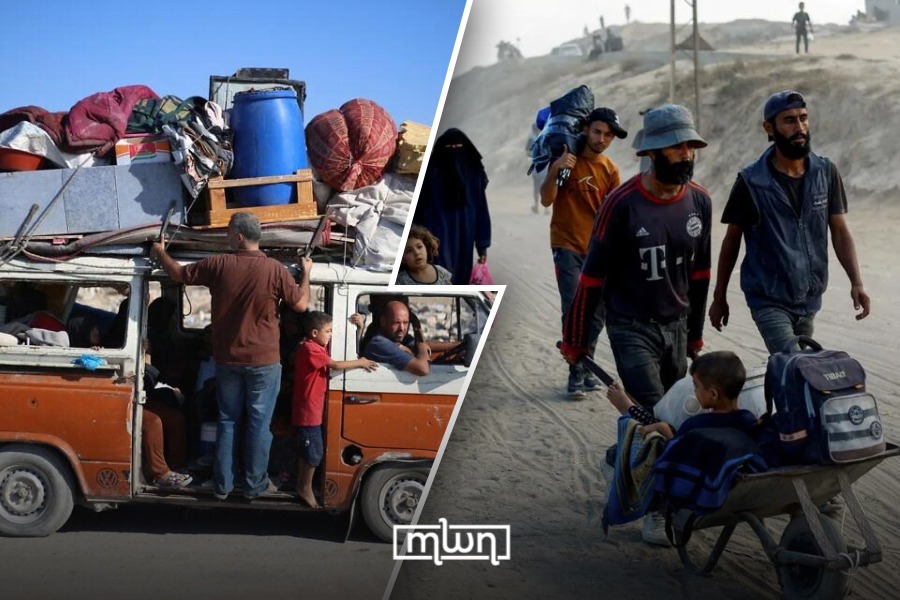
Many routes out of the city are already choked with fleeing refugees; others say they have no place safe to go as the Israeli Occupation Forces (IOF) advance into Gaza City.
In order to leave, some families are selling everything they can, sometimes on black markets. Others are stuck. Some are walking miles over dangerous terrain—many with small children—and some refuse to leave their homes, despite the risks, for fear of permanent displacement.
“Even if we want to leave Gaza City, is there any guarantee we would be able to come back? Will the war ever end? That’s why I prefer to die here, in Sabra, my neighborhood,” Ahmed, a Gazan schoolteacher, told Reuters.
How are families getting out?
Palestinians have attempted to flee since the start of Israel’s genocide in October 2023. Since then, it has become increasingly difficult for Gazans to leave.
Only some foreign passport holders and their dependents—as well as some of the gravely injured or ill—have been able to cross the blockades guarding Gaza’s borders. For those without such passports, families are turning to privately-operated exits, many of which are managed by Egyptian brokers—and usually charge anywhere from $6,000 to $12,000 to help a single person escape within 72 hours.
Before the genocide, the same brokers charged about $350 per person.
Gazans are also reaching out for individual donations via online campaigns, usually privately organized on platforms such as Instagram, X, and Facebook, but many report that actually accessing the money is challenging.
Individuals and families who cannot afford to leave Gaza have nevertheless been commanded by Israeli leaders to head towards refugee encampments in the south. Israel has designated these camps as a “humanitarian zone,” but Palestinian and United Nations officials have indicated that there is no safe place in the south—as well as throughout the enclave—for these refugees. These camps are reportedly overcrowded, lack adequate food supplies, and subject to constant IOF bombardment.
Gazans who wish to obtain food from designated aid distribution points also risk attacks from IOF snipers, including when they attempt to access aid from US and Israel-backed Gaza Humanitarian Foundation (GHF) sites. The UN has called for the dismantling of the GHF and have accused it of politicizing and weaponizing aid. As of August 2025, of 1,760 Palestinians killed since May 27 while seeking food, 994 perished at GHF sites.
[ad_2]
Source link