
[ad_1]
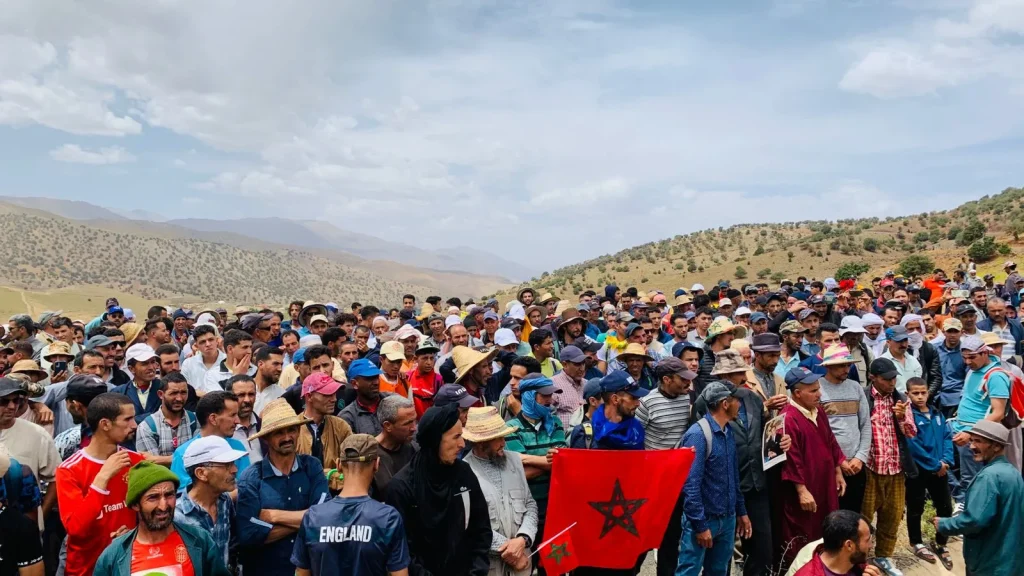
Rabat – In the early hours of Wednesday, July 9, 2025, more than a thousand residents from Aït Bouguemez, a picturesque valley in Morocco’s High Atlas Mountains, set out on a long, determined march toward the provincial and regional authorities.
Their destination: the Azilal provincial headquarters and, beyond it, the Beni Mellal-Khenifra regional capital. Their message: a plea for dignity, development, and an end to years of what they call systematic marginalization.
Known as “The Happy Valley” for its stunning landscapes and serene atmosphere, Aït Bouguemez is home to 27 villages scattered across the mountains of Azilal province. But, behind the postcard scenery lies a population growing increasingly frustrated with poor infrastructure, inadequate public services, and stalled development. For weeks, tensions have been rising as residents voiced their grievances through formal channels, but to little avail.
On Wednesday, they decided to escalate their action. In an act of collective defiance and civic responsibility, more than a thousand men, joined by the president of the Tabant rural commune, Khaled Tougougun, set out on foot toward Azilal, covering roughly 77 kilometers. The marchers carried no weapons, displayed no aggression, and followed all the principles of a peaceful protest.
Yet, even their peaceful determination was met with obstacles. As they approached the Tizi N’Terghist mountain pass, security forces blocked the road with vehicles, forcing the marchers to divert to an alternative route. Despite this, they continued, embodying what one observer called “the highest level of awareness and discipline.”
At the heart of their demands is the need for a resident doctor. For years, the valley’s health center has operated without a full-time physician, leaving residents dependent on distant hospitals for even the most basic care. “There are only nurses,” said Hassan Laakoun, a local resident who was onsite at the protest, describing how medical emergencies often turn into tragedies because of the delays in reaching proper treatment.
Equally urgent is the state of the roads. Regional road 302, which connects Aït Bouguemez to Tizi N’Terghist, and road 317 to Aït Abbas are both in disrepair, becoming nearly impassable during winter snowfalls. Residents say the lack of maintenance isolates entire villages for weeks at a time.
Connectivity is another critical issue. Many areas still have no reliable phone or internet service, making it nearly impossible for families to communicate with the outside world or access information and services. Even during a phone call with a resident, the connection repeatedly dropped, underscoring the scale of the problem.
But their demands go beyond just healthcare and infrastructure. The villagers are asking for a community sports field to give local youth a safe space to play and socialize, a training center for mountain-related trades aligned with the region’s geography and economic potential, and a school to reduce the alarming dropout rates among children. They also call for small dams to mitigate the impact of seasonal floods, which regularly damage homes and farmland.
Lastly, the residents want an end to housing permit restrictions caused by the absence of an urban development plan. This bureaucratic deadlock has left many families unable to build or improve homes in their own villages, trapping them in inadequate housing.
Wednesday’s march was as much a cry for help, as it was a testament to the resilience and civic maturity of Aït Bouguemez’s people. They walked in gratitude and trust, believing in the promises made by the authorities and hopeful their voices would finally be heard.
[ad_2]
Source link