
[ad_1]
Generation Z has emerged as a global movement, reshaping political life from Africa to Asia and beyond. Digitally native, globally networked, and unwilling to accept the failures of entrenched elites, Gen Z has channeled its discontent into new forms of activism and protest. Across diverse contexts, the demands of this generation converge: fair access to quality education, reliable healthcare, decent employment, and governance that emphasizes institutional substance over rhetorical performance.
From confronting corruption in Nigeria to resisting inflation in Kenya, exposing democratic erosion in Senegal, denouncing elite detachment in Nepal, and even contributing to the collapse of a government in Madagascar, Gen Z articulates a shared language of urgency.
The message is clear: leaders must invest in the future rather than mortgage it. What appears at first as episodic unrest is in fact a generational project—an explicit refusal to inherit systems of corruption (al fasaad in Arabic), inequality, and neglect, and a call to reimagine futures anchored in dignity, accountability, and possibility.
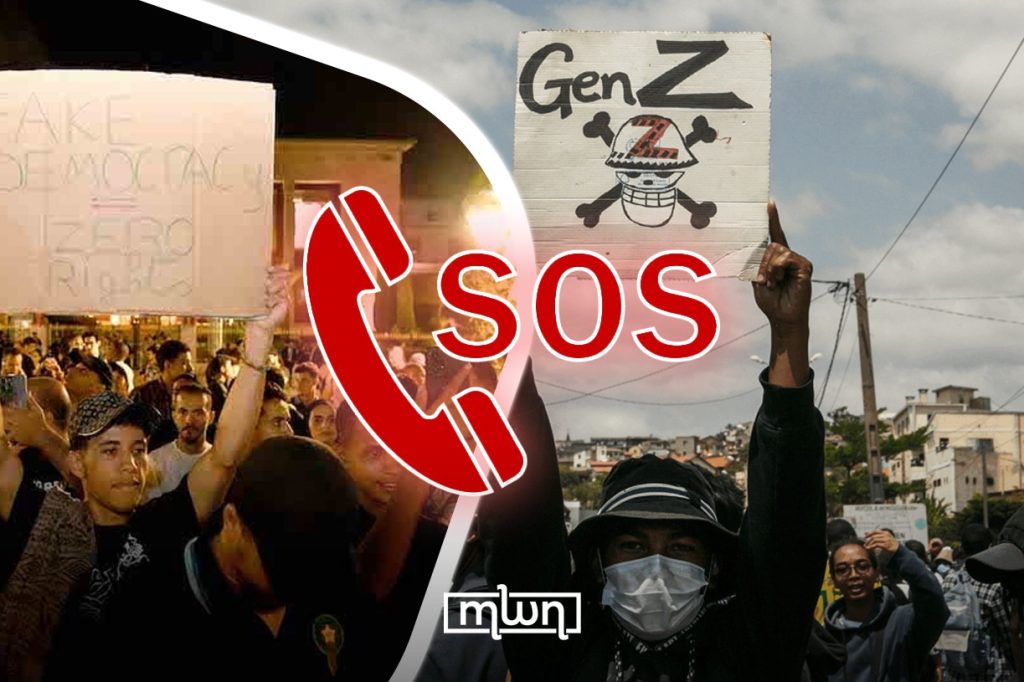
On Saturday, September 28, 2025, Morocco’s streets erupted with the anger of Generation Z. Organized online by the youth collective GenZ212—a name that fuses their generational identity with Morocco’s international dialing code—demonstrations swept across Rabat, Casablanca, Agadir, Tangier, Marrakesh, Oujda, and more than half a dozen other cities. What began on a Saturday swelled into a multi-day wave of protests, coordinated not through political parties or unions but through TikTok, Instagram, and Discord.
Their demands were blunt: stop pouring billions into stadiums for the Africa Cup of Nations in December 2025 and the 2030 FIFA World Cup, and start repairing the nation’s collapsing schools, underfunded hospitals, and creating decent jobs for its unemployed youth. The slogan “Health before football” quickly became a rallying cry, capturing the generational frustration. For young people raised in scarcity and precarity, this was more than a protest about sports. It was a denunciation of corruption—a political order that privileges spectacle over survival, classrooms, hospitals, and jobs.
This eruption, however, is not an isolated moment. It is the third chapter in a much longer story of protest fighting against corruption in Morocco. American political scientist John Waterbury argued in his 1970 classic on Moroccan politics “The Commander of the Faithful” that corruption was not a deviation but a deliberate instrument of rule, embedded in the very logic of governance. Three decades later, the late Négib Bouderbala, in his landmark 2001 UNDP–OECD report “La lutte contre la corruption: le cas du Maroc”, emphasized that corruption had become structural, operating through patronage networks that diverted and redistributed public resources.
Bouderbala observed that corruption had become “banalized”—simultaneously condemned and normalized, treated as an outrage in principle but tolerated as a fact of daily life. In his analysis, corruption was not simply misconduct but a system of survival, where advancement depended less on merit than on illicit rewards, and where loyalties were secured through clientelism. By the early 2000’s corruption had also become culturally normalized, reflecting a deeper deficit in civic morality that undermined the public good.
The third chapter is unfolding now, as GenZ212 channels these long-standing critiques into a generational movement that refuses to accept corruption as the price of survival. Unlike earlier calls for social change, however, this movement does not stop at diagnosis: it signals a rupture, transforming corruption from an entrenched system into a rallying point for change, and demanding that governance be rebuilt on dignity, transparency, and the public good.
The protests themselves emerged from converging grievances. Anger sharpened after eight pregnant women died in a public hospital in Agadir in August 2025, an incident protesters see as a brutal symbol of deepening inequality. At the same time, youth contrast gleaming new stadium projects with failing schools, high unemployment, and rising living costs. The decentralized and anonymous nature of GenZ212, organized largely through Discord and TikTok, made the protests both resilient and difficult for the authorities to manage.
By late September, demonstrations had spread to 11 cities, with rights groups reporting nearly two hundred arrests and footage circulating of police violence against demonstrators. Although most detainees were released, human rights organizations condemned the crackdown as an attack on freedom of expression. As of October 1, the protests had escalated into violent confrontation. The Interior Ministry reported more than 400 arrests, 263 injured security officers, and damage to 142 police vehicles, alongside 20 privately owned cars vandalized and 23 civilians injured. Most seriously, two protesters were killed in the southern town of Lqliaa when police opened fire, reportedly in self-defense.
In the Moroccan context, although formal laws and statutes addressing corruption are inscribed within the legal corpus, their weak and inconsistent enforcement has generated a de facto order in which informal practices of exchange and patronage frequently override codified legality. As Bouderbala theorized through his notion of banalization, corruption became embedded in the most ordinary domains of social and political life, where metaphors drawn from food, tools, proverbs, and even government vehicles structure the language of daily exchange, encoding bribery and patronage as normalized practices.
Small bribes were “sweetened” with familiar words like sukar, hlawa, qahwa (Arabic for sugar, sweets, coffee), shorthand for gratuities given in exchange for services. Someone adept at extracting benefits might be described as ta yahlab bhal khotu (he milks like his brothers) or taya’raf mnin yakul el ktaf (he knows where to begin eating a shoulder), suggesting a knack for arranging affairs. To pay a bribe was to dhan assir issir (grease the shoelace so it passes). A sharp operator was hada zizoir (that one is a razor), while hada masmar (that one is a nail) referred to someone who exploits his/her position. Most evocative is the saw: kil manshar, tala’ yakul, nazal yakul—“like the saw, he eats going up and he eats coming down”—a metaphor for relentless corruption consumption at every turn.
The lexicon of corruption extends into justice, religion, and government. Haqek (“your right”) came to mean “your share of the deal.” Expressions like dawar m’aya (“turn with me or give me something”) and nwa’ari (from the waterwheel, implying “going in circles”) normalized reciprocity as corruption. Religious idioms were co-opted as well: bini ou binek Sidi Qacem (“between you and me there is only the saint Sidi Qacem”) invoked a holy figure known for generosity, recast as a demand to split spoils. Even state symbols entered this vocabulary: the Arabic letter jim, stamped on government license plates, gave rise to jim f-jjib (“the jim in the pocket”), shorthand for embezzlement of public property. French terms like cadeau, pot-de-vin, commission, and pourcentage slipped easily into Moroccan Arabic, further evidence of corruption’s cultural entrenchment (Bouderbala 2001:12–14).
This diffusion of corruption into the very texture of speech was what Bouderbala called its banalization: simultaneously condemned and normalized, denounced as immoral yet reproduced as ordinary practice. Language itself became an accomplice, recasting corruption as everyday survival rather than systemic failure.
Seen against this backdrop, the slogans of Gen Z—“Health before football” above all—mark a decisive rupture. The symbolism of the protests made their critique unmistakable. Every chant of “Health before football” pointed to the absurdity of stadiums rising while hospitals failed. The deaths of eight women in Agadir dramatized how neglect and corruption can kill. The chants concerning the unkept promises to rebuild homes destroyed by the 2023 earthquake recalled what Bouderbala once called the “cemetery of unenforced laws.” Stadiums have become metaphors for misplaced priorities, hospitals for abandoned citizens, classrooms for stalled futures, and jobs for dignity deferred.
In contrast to earlier generations who cloaked corruption in euphemisms like hlawa (sweets), qahwa (coffee), or haqek (your right), today’s youth strip away metaphor and confront betrayal directly. The collective GenZ212 is not only challenging corruption in practice but also reshaping the very language through which it is contested—replacing idioms of resignation with a vocabulary of accountability and urgency.
In this sense, the movement signals something Bouderbala believed essential for change: a shift in citizen consciousness. By organizing outside traditional parties and patronage networks, Morocco’s youth are developing a new civic imagination—one that refuses to accept corruption as the price of survival and insists instead on accountability as the foundation of dignity. Their digital platforms—TikTok, Instagram, Discord—function as new public squares, places where solidarity is built and authority challenged, beyond the reach of older forms of co-optation.
But Morocco’s Gen Z is far from standing alone.
Across Africa, Gen Z has become a disruptive political force. In Nigeria, the 2020 EndSARS protests began against police brutality but quickly broadened into a youth-driven indictment of corruption and inequality, fueled by decentralized social media organizing. In Kenya, the #OccupyParliament marches of 2024 and 2025 railed against new taxes and spiraling inflation, condemning elites for enriching themselves while ordinary citizens struggled—an echo of Moroccan youth denouncing stadiums while hospitals collapsed and jobs disappeared.
In Senegal, waves of protest between 2021 and 2023 mobilized thousands against corruption scandals and democratic erosion. And in Madagascar, youth-led unrest in September 2025 contributed to the dissolution of the government, showing the volatility of ignoring digitally connected, impatient generations. Even beyond Africa, parallels resonate. In Nepal, Gen Z protests in 2025 railed against corruption, unemployment, and elite detachment. Young Nepalis accused leaders of chasing prestige projects while neglecting schools, healthcare, and jobs. Their language of betrayal mirrors that of Moroccan youth, who watch stadiums rise even as classrooms crumble, hospitals falter, and livelihoods vanish.
Placed in this wider context, the GenZ212 movement is not an anomaly but part of a generational wave redefining politics. In Morocco, it calls on the state to move beyond showmanship and demonstrate that it still has the capacity to aspire—to transform frustration into meaningful hope for its youth. The choice could not be clearer: either heed the call of GenZ212, or risk watching a generation that refuses the banalization of corruption chart its own path, with or without the state. Stadiums or hospitals, arenas or classrooms, spectacle or jobs, corruption or accountability—Morocco’s future will be decided by how it answers the call of GenZ212.
And yet, it need not be an either/or choice. Football, stadiums, and spectacle can inspire dreams and awaken pride, developments that give a nation a sense of belonging on the global stage. But, those dreams only become real when they stand alongside hospitals that save lives, classrooms that nurture minds, and jobs that sustain dignity. The true capacity to aspire is born when spectacle and survival reinforce one another—when national pride is matched by tangible investments in human development. Morocco’s challenge, and its opportunity, lies in showing that the roar of the stadium can coexist with the quiet strength of schools, hospitals, and livelihoods that make a better future possible for all.
The name GenZ212 is more than clever branding. It is an SOS, a coded call linking Moroccan youth to the wider world through the country’s international dialing code. It signals urgency: a generation demanding that the state shift from spectacle to substance, from showmanship to service. “Health before football” captures the fury of the moment, but it also contains a vision: health with football, education with spectacle, jobs with pride. That is the Morocco its youth are calling for—a Morocco where dreams on the pitch and hopes in daily life advance together, not apart.
The SOS of GenZ212 is not only national. It resonates across Africa and beyond, connecting Moroccan youth to peers in Nigeria, Kenya, Senegal, Madagascar, and Nepal who are likewise demanding dignity, accountability, and a future worth inheriting. The number “212” becomes both a local code and a global signal, situating Moroccan protests within a generational wave of digitally connected activism that refuses to accept corruption as destiny. It is a call that must be heeded, not just by Morocco’s authorities but by all who recognize that the capacity to aspire depends on institutions that deliver, leaders who listen, and states that serve.
The warning is clear.
As Waterbury first argued in 1970, and as Bouderbala diagnosed again in 2001, corruption in Morocco has never been incidental. It has been the operating logic of the state—planned, cultivated, and normalized. The voices of GenZ212 now carry this critique into the 21st century, forming the third chapter in a half-century cycle of protest and diagnosis. A digitally connected generation is no longer willing to accept the banalization of corruption that their parents and grandparents endured.
Morocco now faces a choice: pick up the SOS of its youth and respond with real reforms or let it drift into voicemail and/or silence. One thing is for certain – this gritty generation will not hang up. Their call will keep ringing, louder each time, until Morocco answers. The nation’s future depends on how the state chooses to respond.
[ad_2]
Source link