
[ad_1]
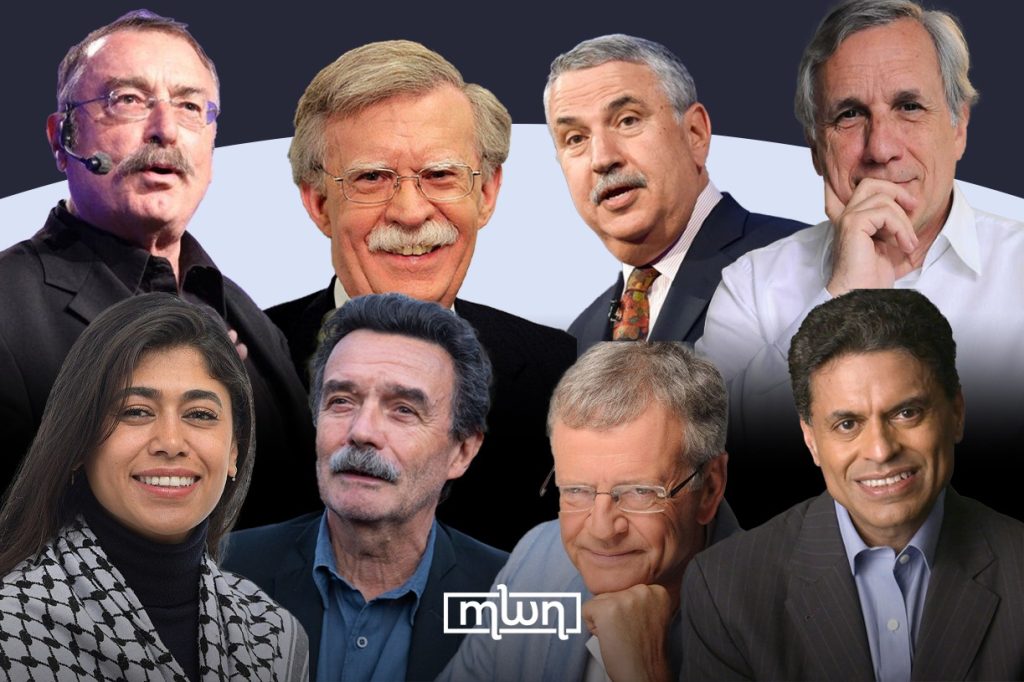
There are names that are making headlines. They happen to turn their columns into both a weapon in the fight for freedom of the press—according to their vision of freedom—and—incidentally—a bargaining chip to make ends meet. Who are they? John Bolton, Rima Hassan, Paul Balta, Fareed Zakaria, Thomas Friedman, Jean-Marie Colombani, Edwy Plenel, Ignacio Ramonet, Pascal Boniface, etc., are among others who have been drawing attention over the last four decades. It would be unfair of me to put everyone in the same basket, and even less to talk about baksheesh (bribery) or lack of sound objectivity, which some are famous for. They have my esteem.
However, these well-known journalists and writers share an undeniable fact: they have become some sort of scarecrows to scare or get political regimes and politicians, and readers in the Arab and African periphery feel a permanent unease.
These journalists and writers follow the same line as do politicians who have gained fame on the backs of Arab and African peripheries. I remember a scene in 2012 when I was in the company of a Moroccan statesman, who was very well-known for his calm and restraint. We were taking part in an international conference.
It occurred to me that I was a witness of an unbelievable scene back in 2012. I remember a well-known European personality headed toward us. She greeted my companion with deference and respect that is obviously exaggerated. A brief discussion followed, during which the foreign personality realized that her words sounded hollow. The message she was willing to convey didn’t get through. She spoke like an empty shell.
She took leave of us. The Moroccan statesman commented, “It’s still incredible that personalities of this magnitude lose their way and seek to clear themselves in the south after their star has faded in the north. This person you have just seen, very magnanimous, very courteous, and measuring her words, had, in the past, given our country a hard time. And wrongly, I must emphasize. Now that she is no longer in the circle of designated detractors, she doesn’t miss any conference to try to regain her lost fame.”
And after chasing away a fly that was bothering him, the Moroccan statesman went on: “You see how she’s treated. No one pays her any attention. I’m sure half of the participants have a grudge against her. Well, what matters is credibility. She doesn’t have any anymore. She had never had any, given the cavalier positions she took at every turn. There was a time when we Moroccans gave too much importance to people who didn’t deserve it. We had gaps to fill; they took advantage of it to blackmail us.”
Yes, there was a time when fragile institutional structures in our countries provided the ideal pretext for conscientious objectors in the West, allowing them to stroll through our mental structures with ease and insolence. Most countries had just gained or regained their independence. They were subject to institutional adjustments or readjustments—often in haste—precisely so as not to appear adamant about change.
The triumphant West, facing an East that had held its own, controls the scene and places its relays in peripheries lost in identity aspirations and here-and-now urgent demands. These peripheries become a promising market for the implementation of societal projects that, it was believed, had worked perfectly in both the West and East camps.
But let’s not get lost! The list of politicians, journalists, and writers concocted at the beginning of this paper calls out to us, the readers who belong to these Middle Eastern and African peripheries. Why? Because we are invited to think twice before joining this jerk of denigration or apology that comes to us from the West and the East. Exactly, there are also too many apologists who insult our intelligence.
Chameleons and scarecrows
However, what might be astounding is the fact that schizophrenia is contagious. It becomes even more dangerous when it is accompanied by amnesia. Schizophrenia and amnesia plunge the mind into cognitive aberration when they run their course in the market of denial and random resourcefulness.
The media campaigns that smear the Arab and African countries’ reputation are not isolated incidents initiated by zealous politicians, journalists, and writers. They are part of a package that includes lobbying, blackmail, pressure, deterrence, and persuasion.
They play the symphony of the sword of Damocles and the Achilles heel wonderfully. And I can say without the risk of hurting that this is poorly played by opportunists who have newly joined the choir. Because the periphery is no longer the same periphery, and the center is no longer the same center.
By the same token, the lobbying carried out remotely by sponsors thirsty for domination that is starting to slip through their fingers is now done in reverse. There is a staggering lack of inspiration and imagination. Classical lobbying implemented according to a hegemonic conception of interstate relations can no longer hit the mark.
Lobbying, an accepted term for bargaining to win a deal, smells burnt when it is blatantly associated with blackmail. Observers well remember the blackmail serial that countries like Egypt, Tunisia, Libya, Jordan, Lebanon, Syria, Qatar, the United Arab Emirates, and Morocco were subjected to for more than five decades. Articles, books, and documentaries were commissioned to ensure that these countries, among others, absorbed the messages being sent to them.
Egypt first. Egypt was praised following the signing of the peace treaty with Israel in 1978. Fair enough. Egypt, involved in four deadly wars since 1948, could do no better than think of patching up the breaches and getting back on its feet again. That was without taking into account the spine of history, which dictates that painful concessions remain painful and snowball. Strangled, Egypt is cornered into making even more concessions. The cold war against Israel is costly.
In the wake of the entry into the fray of the Islamic experience of governance since 1979, the date of the Islamic revolution in Iran, and the rise to power of the Islamists in Turkiye in 1996, Egypt finds itself suffocated. Indeed, the sponsors of change through the promotion of political Islam have been working to ensure that the Muslim Brotherhood Movement comes to power.
President Hosni Mubarak, who was asked to pressure the Palestinians at Camp David and Sharm-el-Sheikh in 2000 to accept a peace agreement in humiliation, refuses to go any further. It is enough that he hurled at Yasser Arafat all sorts of names during a negotiation that left those present speechless. A campaign of vilification is launched by think tanks and newspapers in the US, the UK, and France. “The Arab Spring” occurs in surprising circumstances, and Mubarak is overthrown.
“The Arab Spring,” the first flame, is lit in Tunisia. Precisely Tunisia, which is presented in Western media as an enlightened authoritarian regime. Zine El Abidine Ben Ali seizes power without bloodshed in 1987. He ends the reign of Habib Bourguiba, who is aging. Ben Ali takes cynicism to the point of visiting the latter once he takes up residence in the Carthage Palace.
Tunisia has been under the best auspices for twenty years. Then, in the wake of the changes aimed at and sponsored by political and strategic planning centers in the West, Ben Ali sees the lucky star that accompanied his rise fade away without further notice. The ousting of Ben Ali is planned and well-known; pens used as scarecrows are already at work (Graciet Catherine et Beau Nicholas, La régente de Carthage, 2009).
Ben Ali is overthrown following the riots caused by Bouazizi’s hecatomb. His mode of government, encouraged a few years earlier and described as soft authoritarianism, no longer pays off in the eyes of Western political planners and strategists—those very same people who had turned a blind eye to his human rights abuses for two decades. He dies in exile, in Saudi Arabia, in 2019.
Neighboring countries feel the tectonic aftershock and start to brood. So is Libya. Muammar Gaddafi was a very smart leader. He saw storms brewing on the political and strategic landscape. He knew things, he, whose rise to power was organized by those very people who began seeking his head in the aftermath of the second Gulf War (1991-1992).
Kadhafi raised the stakes to save his skin. Too late. His rapprochement with Berlusconi’s Italy and Sarkozy’s France was of no use to him. The time for compromises for both parties could no longer be repeated. Commissioned articles and books repeated the same refrain to weaken him and push him to make more concessions (John Oakes, The History of Gaddafi’s Pariah State, 2011).
The rush of events in the aftermath of the Arab Spring blew away Gaddafi’s power. He was eliminated in a way that still intrigues. Gaddafi, who had vowed to topple the Moroccan, Saudi, and Jordanian monarchies, did not have time to realize his fate was sealed. Of all the monarchies that had suffered Gaddafi’s threats and plots, there was Jordan.
Jordan, which lives according to the whims of its neighbors and the complex components of its tribal structure, has had its share of denigration and attempted coups. In addition to the burdens related to Jordan’s history, the controversial passage of time during the rivalries between Great Britain and the Ottoman Empire, the organic relationship with the Palestinian issue, and the status of al-Quds, there is the weight of the changes taking shape in the Middle East that want to make Jordan the country to be sacrificed.
This seemed unequivocal during the early months of the Arab Spring (2011-2012) and in the aftermath of the launch of what had been labeled the “normalization process of relations between Israel and all the countries of the region” (Abraham Accords, 2020). It follows that the professionals of the pen do not skimp on means to belittle the political and civilizational contribution to intranational and regional stability that Jordan fortunately plays. Jordan has withstood the chaos that was caused by the Syrian civil war and its impact on neighboring countries, notably Iraq and Lebanon.
Syria and Lebanon present a particular case, as irredentism was motivated by the memory of the reshaping of the Middle East in the aftermath of the Sykes-Picot Agreement (1916), the breakup of the Baath Party (1966), and the Lebanese Civil War (1975-1990). The double game that Assad’s Syria played in the Arab-Israeli conflict led to the proliferation of writings and theses inspired both by the former colonial powers and by the fervor of Arab nationalism, straddling propaganda and the geopolitical reality of the 1960s-1990s.
Lebanese writers (Ghassan Salamé, Amine Maalouf, etc.) and Syrian writers (Sadeq J. Al-Azm, etc.), who have intermittently or permanently taken up residence in the West, have fueled the debate on the specificity of relations between Lebanon and Syria. Iran’s entry into the fray has somewhat dampened their enthusiasm and altered their perception of international political dynamics.
The twists and turns experienced by both countries in the aftermath of the Arab Spring have been sufficiently reported in local and international media. And for good reason, they bore the brunt of the counter-revolution organized by some neighboring countries that neutralized the actors propelled onto the Middle Eastern political chessboard in 2011. One of the key players in the counter-revolution was the United Arab Emirates.
The United Arab Emirates is riding high. They have displayed the ambition to become an important regional player since the success of the unification initiated in 1971. If the various political transitions have generated a lot of ink, they have also been motivated by geopolitical readings that go beyond the issue of irredentism or the existence or non-existence of a proven state tradition.
In full bloom, the United Arab Emirates are pinned down by writings that draw their material for embroidery from the considerations mentioned earlier (Sami Al-Jalouli, The Emirates Before the Disaster, Secrets and Mysteries, سامي الجلولي، الإمارات قبل الكارثة، أسرار و خفايا، 2018). The UAE’s ambitions are causing a stir. The UAE has ambitions that go beyond its geographical space. They are disruptive.
The narrative on normalization with Israel, the aftermath of historical rivalries, and the upheaval in the regional geostrategic landscape are fueling interpersonal animosities among leaders. They reached their peak in 2017, the year the UAE, Saudi Arabia, Bahrain, and Egypt joined forces to try to invade another neighboring country, Qatar.
The Qatar saga is impressive. Here is a country that is entangled and, with the help of historical memory, is trying to be reborn in international politics and, along the way, settle scores with its neighbors, those very ones who, in one way or another, benefited from the Sykes-Picot agreements.
The country takes flight, thanks to the end of the Cold War. He is entrusted with a specific mission within the framework of the “regime change” paradigm to promote political Islam. Taking this mission seriously by siding or competing with Turkiye, he gets his wires crossed. The complicity between the two turns sour. The rest is well-known.
Qatar aims to clear its name through a series of mediations in various conflicts in the Middle East and Africa. This ambition has drawn the wrath of professional writers serving sponsors who operate in the shadows to smear Doha’s reputation. (Beau Nicholas & Bourget Jacques-Marie, Le Vilain Petit Qatar: Cet ami qui nous veut du mal, 2013)
Qatar is criticized for its alleged greed and ambitions in the world of finance and investments, aiming to become a top lobbyist on the political chessboard in some European countries. Thus, it was no surprise to see commenters make fun of this country when Israel targeted buildings in Doha where a few of Hamas’s leaders took shelter to hold secret meetings ahead of a potential deal with Tel Aviv to end the war in Gaza and release the Israeli hostages.
Dissonance and empty shells
Although it has learned the lesson in its immediate neighborhood, Qatar errs on the side of overzealousness. She sometimes allows herself to mingle in the Maghreb political and diplomatic chessboard. She indirectly causes trouble through the Al Jazeera channel. Al Jazeera is the perfect tool in the hands of Qatar for exerting pressure and bargaining. A biased technique based on contradictory interests toward Arab countries, including, sometimes, Morocco.
Seasoned diplomats don’t understand the dual language Doha uses with respect to Morocco’s territorial integrity. While officially she supports Morocco, she allows Al Jazeera to use lethal weapons to hurt its vital interests. Some would say that all this is a fine art of double-edged diplomacy.
Yes, Morocco, which has recently been the target of a media campaign that attempts to sow doubt in the minds of Moroccans regarding their institutions and the achievements made in various fields. And so, it’s Morocco’s turn.
Morocco intrigues. It intrigues because the country, on the eve and in the aftermath of its independence, has been the target of multifaceted destabilization projects. These projects continue up till now. The approach is the same: to openly pit the monarchical institution, the opposition forces, and the common people against each other. A gamble that has failed every time. But the opponents do not give up.
Attempts to destabilize Morocco focus on the backbone of the mental structure of Moroccans (decision-makers, elites, composite political and trade union movements, and ordinary citizens) to hamper the process of fully achieving its territorial integrity. Far be it from me to insinuate the conspiracy theory, yet what is happening reminds me of the adversity toward Morocco that goes back to the years of 1884-1889, 1904, 1906, 1911, 1912, 1933, 1954, 1959, 1962, 1963, 1965, 1969, 1970, 1973, 1975, 1979, 1982, and 1994.
Whenever Morocco has demonstrated unwavering resilience, it has been targeted in its territorial integrity or in the legitimacy of its institutions. The predators, who present themselves as Samaritans, have no qualms about transitioning from praise (Laurent Éric, Hassan II, la Mémoire d’un Roi, Entretiens, 1993) to degradation with the deliberate intention of provoking rebellion (Perrault Gilles, Notre ami le Roi, 1990; Graciet Catherine et Laurent Éric, le Roi prédateur, 2012).
It would be pointless to go back to the last campaign orchestrated from France, which was a resounding failure. However, I will not resist the temptation to be more prolific about the reason I listed a number of politicians, journalists, and writers at the beginning of this article who have made a living out of their interest in Middle Eastern, African, and Maghreb affairs. I will emphasize those who have recently been in the spotlight.
First of all, John Bolton. The story of John Bolton reminds me of an anecdote I experienced when I had just joined the Department of Foreign Affairs. My supervisor, a person who was my true mentor and to whom I owe much of what I have become professionally, gives me a copy of John Damis’s book on the Sahara issue (John Damis, Conflict in Northwest Africa: The Western Sahara Dispute, 1984).
He asks me what I think, adding that this American professor is fundamentally anti-Moroccan. I tell him that Damis is not anti-Moroccan, but that he is among the few American scholars who have really taken an interest in the Moroccan Sahara issue without bias. History proves me right, as Damis becomes, a few years later, one of the auditors committed to the Moroccan cause before the United Nations Fourth Committee.
What is the relationship between John Damis and John Bolton? Damis was a scholar of some note. In his early writings on the Sahara issue, he described the Polisario as a “national liberation movement.” As he advanced in his research, he came to the conclusion that this movement did not meet this description and that it was merely an instrument in the hands of Algeria.
Bolton, who was a member of James Baker’s team, the personal envoy of the United Nations Secretary-General for the Sahara (1999-2004), held a grudge against Morocco, which thwarted the Baker II plan that was going to, through a hectic legal artifice, lead to the territory’s independence.
Better than blind stubbornness, Bolton, who claims to be a reinvented neoconservative, is a proponent of a strong hand to resolve international conflicts, but according to a biased approach that would allow him, as a warmonger, to combine the useful with the pleasant. A stance he defended on the occasion of the various positions he held within the American administration and within interest groups linked to the military-industrial complex.
The reinvented neo-conservatism presents a space in which people who claim to be liberals, socialists, religious, existentialists, anarchists, etc. are very active. These currents of thought and beliefs are expressed differently in some European countries. The neo-conservatism movement is working tirelessly to end all forms of exception or cultural specificity. It adopts an expeditious approach in the perception of international conflicts.
Although they may argue about it, the journalists and writers mentioned above, such as Paul Balta, Edwy Plenel, Ignacio Ramonet, and Pascal Boniface, are not far from topping the list of defenders of the regime change paradigm in the Middle East and Africa by force. Some of them, like Pascal Boniface, can be put on the spot for adopting a position deemed balanced but favorable to the Palestinians, for example.
Gravediggers on duty versus virtual philanthropists
Indeed, the Middle East is the ideal barometer to debate the narrative of American journalists and writers. Fareed Zakaria and Thomas L. Friedman stand out from the crowd due to their abundant production as columnists for The New York Times, The Washington Post, Newsweek, etc., and as writers. They stand out due to the contact list and reliable sources they have to get the scoops.
In short, they present this relevant means in the hands of American decision-makers to prepare American public opinion and international public opinion to swallow the impact of key decisions related to the management of international conflicts, particularly in the Middle East.
What about the politicians? Rima Hassan, who has recently voiced contradictory positions regarding Maghreb affairs, has cleverly managed to play her Palestinian origin and her membership in the left wing on the French political chessboard. In addition to her positions within the European Parliament, she has been involved in defending Algeria’s narrative regarding the regional conflict over the Sahara.
Rima Hassan’s support for the Polisario seemed unconditional until she launched deadly arrows challenging the Algerian-Polisarian narrative. She firmly rejected any analogy or similarity between “the Palestinian cause” and what is defended by Algeria as “the Sahrawi cause.” This began last year and has continued as France’s official position on this conflict has evolved in favor of Morocco.
The dual role of being of Palestinian origin and a left-wing activist in favor of the Polisario could no longer be worn randomly. Movements and voices close to the Algerian authorities then cried scandal. The wind of change in the perception of Maghreb affairs thus displeases decision-makers who have fed on the supposed misery of the Sahrawi populations held against their will in the Tindouf camps.
Ideological stubbornness and lack of visibility mean that respected writers from the 1970s-2020s are choosing to forge ahead. The way Paul Balta, Edwy Plenel, Ignacio Ramonet, and Pascal Boniface shout to suggest that the international system and regional subsystems have not fundamentally changed despite the collapse of the USSR, the end of the classic Cold War, and the failure of the Western regime change strategy in the Arab and African peripheries raises legitimate questions about their intellectual honesty.
Lacking arguments that allowed them in the past to gain points on the chessboard of the free press, they then prefer the scarecrow tactic. They always want to scare and openly join the political campaigns to denigrate countries that express their determination to break free from the grip of the post-independence dictate exercised by the former colonial powers.
Facing them, and in a zigzagging surge of ideological solidarity, are figures of indigenous intellectual opposition. There too, pens and voices are in despair and no longer know which saint to turn to. The shock of discovering that the West, which they have so cherished and adored, has agendas that can harm the interests of their countries, cools them down. Be that as it may, they persist and sign by striving to shift the blame onto the latter.
Certainly, there are deficits and challenges to meet. Political and economic decision-makers in these countries have things to be criticized for in terms of management and governance, but the total upheaval that some pens demand in the sense of making a clean sweep is not realistic. It is dangerous, like the accelerated reforms undertaken that do not take into account the pillars on which the steps taken and accompanying measures are based.
Sometimes, one gets the impression that the voices and pens so respected, so feared, and so going around in circles do not realize that serious and profound changes are taking place in the foreign societies they use as a business. Nor do they understand that politicians who jump into the swamps of asymmetrical state relations without precautions reveal their ignorance if not their incompetence.
These voices and pens are mostly unaware of the fact that they can no longer fool societies that, despite the digital divide, manage to read the thoughts of the gravediggers on duty wearing masks of philanthropists.
To add insult to injury, for two decades, in the West, politicians, journalists, lobbyists, and scholars have been repeating the same mistakes in their assessment and understanding of the Middle East and North Africa (Martin Kramer, Ivory Towers on Sand: The Failure of Middle East Studies in America, The Washington Institute for Near East Policy, 2001). Martin Kramer is right, as were before him Edward Saïd, Amine Maalouf, Ghassan Salamé, and other enlightened writers. Those whom the West fascinates but yet cannot steal their souls.
[ad_2]
Source link