
[ad_1]
Marrakech – For half a century, the Polisario Front has claimed to be the “sole and legitimate representative” of the Sahrawis, an exclusivity imposed under Algeria’s patronage and maintained by force rather than democratic consent. This monopoly is being increasingly and openly challenged today.
On April 22, 2020, a group of former Polisario officials, led by senior diplomat and ex-minister Hach Ahmed Bericalla (also known as Hach Uld Ahmed), broke ranks to launch the Sahrawi Movement for Peace (MSP).
The initiative built on Bericalla’s earlier attempt to reform the Polisario from within through the 2017 “Iniciativa Saharaui por el Cambio,” which failed to gain recognition.
Elected as First Secretary at MSP’s founding, Bericalla positioned the movement as a non-violent, pro-dialogue alternative determined to “reactivate the original Sahrawi elite” and chart a path away from endless confrontation.
From day one, MSP insisted that “the military path is exhausted” and that Sahrawis could no longer afford to wait in limbo inside refugee camps. Instead, it called for a negotiated settlement under UN auspices and with international guarantees.
Autonomy Plan as a starting point
Central to its program is support for Morocco’s 2007 Autonomy Plan, which the movement describes in Spanish as a “estatuto especial” – a special statute granting Sahrawis executive, legislative, and judicial competencies within Moroccan sovereignty.
In an exclusive interview with Morocco World News (MWN), MSP spokesperson Salek Rahal made clear that Polisario no longer represents the majority of Sahrawis. “Polisario today represents a minority of the population, while the majority in the territory does not relate to it,” he said.
Since the emergence of MSP, he argued, “many Sahrawis see it as providing effective tools to represent them in this difficult situation,” warning that Polisario risks “finding itself without any role in the future of the territory” if it fails to adapt.
MSP considers Morocco’s Autonomy Plan “a starting point and a suitable base for dialogue,” Rahal said, noting that it “aligns closely with the movement’s approach to finding a peaceful political solution without winners or losers.”
He pointed out that this vision overlaps on many points with the Dakar plan adopted by MSP during its October 2023 conference in Senegal. For Rahal, this is “a historic opportunity for Sahrawis to finally escape fifty years of exile and instability.”
The MSP insists on a negotiated political outcome under international guarantees. Its First Secretary, Hach Ahmed Bericalla – a former Polisario diplomat and minister – has consistently argued that “the military route is impossible,” stressing that Morocco’s autonomy offer should be explored as a realistic starting point for compromise and peace.
In a June interview, Hach Ahmed set out the movement’s identity plainly: “We are a movement which, since its creation in 2020, bets on the peaceful path and believes in dialogue to resolve conflicts and controversies.”
In a later opinion piece in August, Bericalla sharpened the tone: “Turning a new page with Morocco, under international supervision and support, may be the last chance for collective salvation… The dilemma is brutally simple: it’s now or never.”
On the role of the United Nations
Asked about the UN’s role, Rahal said MSP has communicated repeatedly with the Secretary-General’s envoy. “The basis of the political process since 1991 is outdated,” he argued, insisting that the envoy must recognize the emergence of new voices.
MSP moved quickly to insert itself into the international conversation. Since 2021, it has addressed multiple letters to UN officials, including a submission to the UN Secretary-General that was circulated to all member states and formally registered as Security Council document S/2021/414.
In these communications, the movement urged the UN to broaden its consultations beyond the Polisario and Algeria, warning that the exclusion of alternative Sahrawi voices perpetuates stalemate.
MSP also called for updating the “database” of actors, challenging Polisario’s decades-old claim to sole representation. “This eternal title of sole and legitimate representative… no longer makes sense,” Hach Ahmed said in a March interview with Spanish outlet Atalayar about his exchanges with the UN envoy.
Since then, letters to envoy Staffan de Mistura have pressed for urgent intervention and for broadening the process to include MSP and other Sahrawi actors.
Rahal said bluntly that the referendum option is dead. “The UN gave enough time to reach an agreement on organizing a referendum before concluding its impossibility,” he asserted.
“All decisions today have gone beyond the referendum and call for a consensual political solution.” He further warned that “clinging to what has become obsolete is a waste of time,” and cautioned that the UN could even “withdraw its mission,” opening the door to instability.
MSP has also widened its diplomatic outreach. A 2023 Europa Press dispatch captured the movement’s push toward Brussels, urging the EU to support a realistic political solution and to press for a negotiated settlement – echoing Security Council language calling for a “realistic, practicable, and enduring solution based on compromise.”
The question of representation
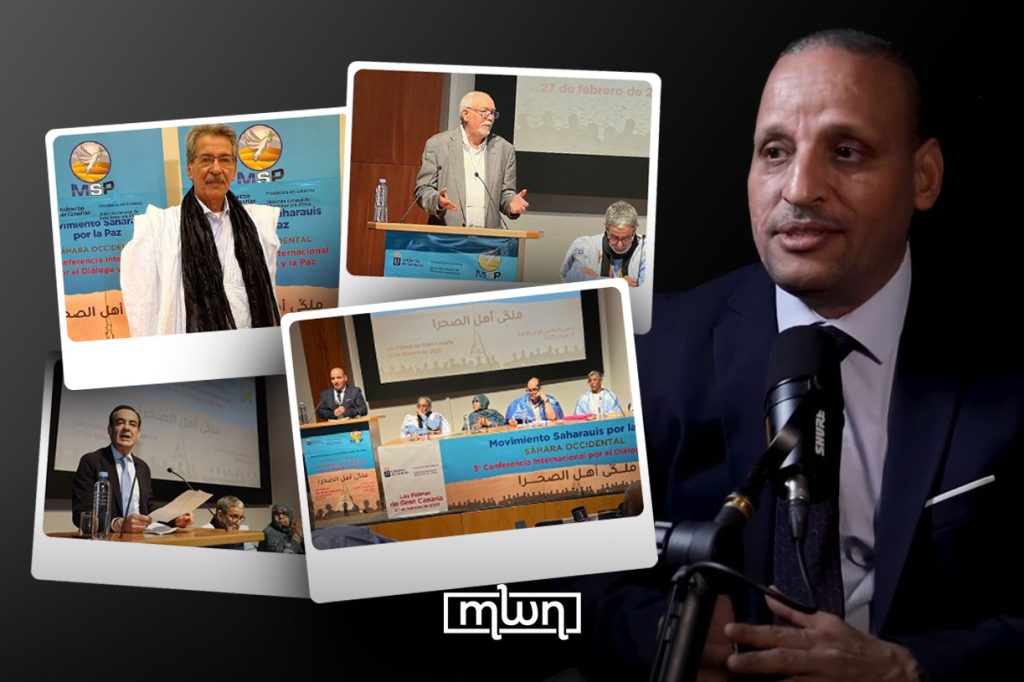
MSP has staged a series of high-profile “International Conference for Dialogue and Peace in Western Sahara” gatherings in Las Palmas (Canary Islands) and beyond, intended to showcase Sahrawi pluralism and push for recognition in the UN track.
The first edition in 2022 produced the “Canary Islands Manifesto I.” MSP pitched it as a call for dialogue and compromise, stressing that Morocco’s Autonomy Plan “inaugurates a new era in which there is room for everyone, and in which everyone can prosper in peace and harmony.”
Prominent Spanish political figures lent weight to the document. Former defense minister José Bono backed the initiative, while former prime minister José Luis Rodríguez Zapatero went further, depicting Spanish Prime Minister Pedro Sánchez’s recognition of Morocco’s Autonomy Plan as both “brave” and “right,” calling autonomy “an intermediate path of self-government” and the best framework for negotiation.
The second conference, held in Dakar, Senegal, in 2023, was co-organized with African partners under the umbrella of CISPAIX. It positioned MSP as a pan-African dialogue platform, culminating in the “Dakar Declaration,” which urged the UN to include MSP as a recognized interlocutor and called for negotiations on the substance of autonomy.
During the third conference, also attended by Zapatero and Bono in February this year, MSP leaders openly stressed that the Polisario no longer speaks for all Sahrawis.
Polisario “is representative of a part of the population, but not of the whole,” Bericalla told Spanish media, reiterating that “the military path is exhausted” and pressing for a democratic, negotiated solution that includes all Sahrawis, both inside and outside the camps.
Bono went further. He bluntly called Moroccan-style autonomy “the most effective formula,” adding: “Sahara’s sovereignty is not a solution… the solution is negotiation, the solution is autonomy.”
MSP co-leader Rahal echoed this sentiment in comments to MWN, stating that “Polisario today represents a minority,” while “MSP offers tools to represent Sahrawis in this difficult situation.”
MSP and its allies described the outcome as the “Canary Islands Manifesto II,” which renewed calls for the UN to recognize the movement as a legitimate interlocutor. The document explicitly urged the Secretary-General’s Personal Envoy to invite MSP to the talks, directly challenging the Polisario’s monopoly on representation.
Momentum for recognition continued in May when MSP was admitted as an observer to the Socialist International (SI) at its Istanbul Council. Both Polisario and MSP-aligned delegations attended events around the venue. Polisario also holds a consultative seat in the same body.
Atalayar published MSP’s thank-you letter quoting Hach Ahmed: “The admission of the MSP to the Socialist International is a gesture in favor of peace and democracy that encourages us to continue striving for a peaceful solution.”
The path to negotiations
Breaking the deadlock requires strong involvement from major powers, Rahal argued, insisting: “We believe the intervention of the United States and France to bring the parties together outside the UN framework could open hope for a near solution,” he said.
He suggested that only direct talks under American, British, and French sponsorship – similar to Dayton or Camp David – could achieve progress. “Relying only on the UN will not differ from Kashmir or Cyprus,” he warned.
Rahal acknowledged the practical difficulties MSP faces. “The challenges are many and diverse, especially logistical,” he said. “The movement depends on modest contributions from members, which often are not enough to cover political activities.” Despite this, he insisted that MSP is “moving in the right direction toward the desired goal.”
MSP maintains direct communication with Sahrawis across multiple geographies. “We are in constant contact with all components of Sahrawi society, whether in the disputed area, the refugee camps, Mauritania, or Europe,” Rahal said.
He explained that the movement uses both direct meetings and social media, and stressed that growing international support for Morocco’s Autonomy Plan strengthens MSP’s case.
“This should encourage the Security Council to move forward with this option,” he said, but cautioned that “Algeria remains the key obstacle. Its position blocks the efforts of all countries supporting the Moroccan plan.”
In fact, MSP has repeatedly condemned lethal incidents around the Tindouf camps and pressed UN officials to intervene. In April, for example, the movement reported that two young Sahrawis were “cold-bloodedly” killed by Algerian soldiers near the camps, warning the UN that these deaths were not isolated incidents but part of a pattern of “regular” shootings and intimidation.
In an urgent communiqué addressed to the UN and MINURSO, the MSP excoriated the “flagrant violations of the most fundamental human rights” that “can no longer be ignored,” demanding immediate intervention to protect civilian refugees held hostage on Algeria’s territory.
“A new tragedy has struck our people: two young Sahrawis were coldly murdered by Algerian soldiers in the refugee camp of Dajla,” the MSP declared. “Lamentably, these atrocities are not isolated incidents. The Sahrawis living in the camps are victims of frequent shootings, intimidations and violent repressions by Algerian forces.”
More broadly, the movement has urged Algeria to take responsibility to curb armed clashes and restore safety in and around the camps. It has also appealed to De Mistura to help stop what it terms the “absurd war” and to secure respect for the ceasefire.
In June, the MSP issued an open letter denouncing the Polisario’s “disastrous policies” in the camps and demanding immediate dialogue. Published from Madrid, the letter warned Sahrawi leaders that “we are at a turning point where we must decide if we persist in a dead-end path or seek realistic, viable and just solutions.”
It blasted the Polisario’s unilateral resumption of war in 2020 as an irredeemable error with “predictable but devastating consequences,” citing Morocco’s drone superiority and the diplomatic collapse of the so-called Sahrawi Republic.
The MSP painted a grim picture of life in the Tindouf camps, warning: “The living conditions are deteriorating rapidly: shortages, insecurity, frustration. Despair has taken hold in the collective mind.”
It accused the Polisario of leading Sahrawis into isolation and irrelevance, arguing that failed insurgencies like the PKK, FARC, or Biafra show the same fate awaits unless dialogue replaces confrontation.
By contrast, the movement pointed to models like Iraqi Kurdistan or Northern Ireland as proof that “political options based on dialogue, in flexible frameworks of coexistence,” can deliver dignity and stability.
Rejecting labels and division, the MSP urged Sahrawi elites to rise above decades of sterile dogma: “It is time to leave behind divisions, acronyms, labels of ‘traitors’ or ‘loyalists,’ ‘heroes’ or ‘villains.’ History will not be lenient with those who, at a crucial moment like this, choose silence or inaction.”
Rahal repeated the same line in the interview: “If Polisario does not seize this opportunity, it may find itself without any role in the future.”
International views
MSP’s visibility has drawn mixed responses. Supportive coverage has described the movement as authentically Sahrawi and non-violent, with Michael Rubin of the American Enterprise Institute (AEI) urging the UN to move beyond what he called Polisario’s “Cold War relic” status.
“It’s time to end the fiction that the Polisario Front represents Sahrawi,” Rubin wrote in April, warning that no Sahrawis had ever elected Polisario to such a position. In a March piece, he went further, branding the Polisario a “Marxist” group that “holds wives and children as hostages to prevent refugee resettlement” in the Tindouf camps.
Critical coverage, however, particularly in Polisario-aligned outlets such as ECSaharaui, describes MSP as a “Moroccan proxy” with limited grassroots support, arguing its visibility comes from Moroccan sponsorship and Spanish political allies.
Nonetheless, in just five years, MSP has positioned itself as a serious alternative voice in the Western Sahara dispute. By advocating autonomy under Moroccan sovereignty, rejecting violence, and pushing for recognition at the UN, it has differentiated itself sharply from Polisario.
Through its international conferences, appeals to the UN, and participation in Socialist International, it seeks to project itself as the peaceful, legitimate, and pluralist Sahrawi option.
Whether this translates into actual negotiating power remains uncertain. Rahal concluded the interview with a call for urgency. “We hope all parties show wisdom after half a century of conflict that cannot bear more delay,” he said. “By involving all components of Sahrawi society, we could see prospects for a solution within the next two years.”
Read also: Polisario Mutiny: Pro-Separatist Sahrawi Media Denounces Brahim Ghali as ‘Failed Tyrant’
[ad_2]
Source link