
[ad_1]
Marrakech – With only days to go before the fifth edition of Marrakech Short Film Festival (MSFF) lights up its courtyards and palm-lined plazas with the glow of cinema, a quiet curator’s eye arrives from Bilbao.
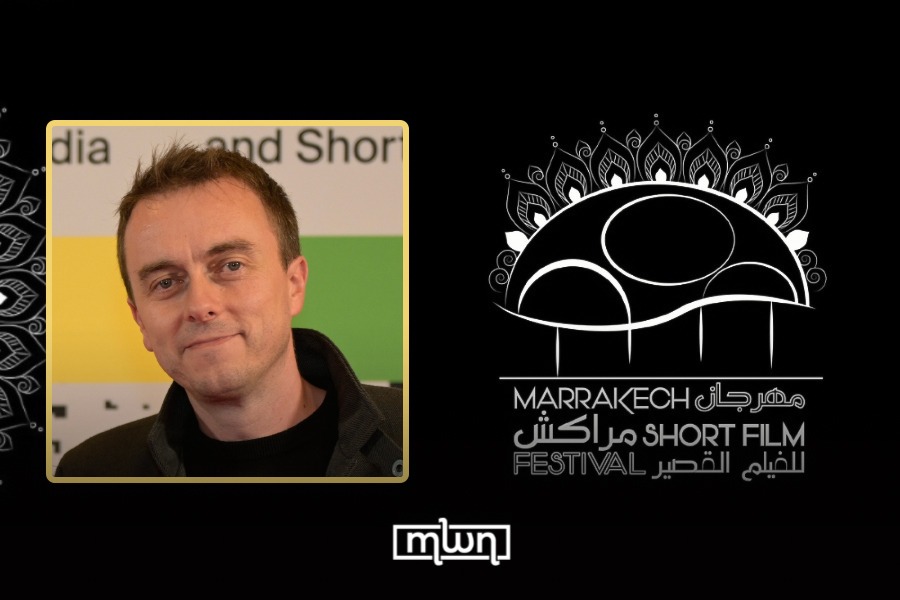
Rubén Corral – head of programming at ZINEBI, the Bilbao International Festival of Documentary and Short Film – has spent years shaping global short film selections. Known as the architect behind ZINEBI’s globe-spanning programs, he has built a career turning thousands of submissions into a handful of defining encounters with the screen.
His taste runs on rigor and curiosity; his compass is the patient labor of watching, comparing, and arguing for films that endure longer than applause. At ZINEBI, this ethos gave structure to a festival with a documentary backbone, a platform where cinematic risk meets cultural reflection. As a member of this year’s MSFF’s international jury, Corral now steps into a city that treats cinema like a public square – where debate and discovery spill past the credits.
It is a fitting crossroads: Bilbao’s meticulous tradition meeting Marrakech’s open-air pulse, with Corral poised exactly where he is most at home – between filmmakers’ risk and audiences’ reward.
Born in Sabiñánigo, Huesca, in 1977, Corral studied Audiovisual Communication at the University of the Basque Country, later earning a Master’s in Multimedia Journalism and a Diploma in Advanced Studies in Spanish Film History.
Since September 2020, he has been programming coordinator of ZINEBI – Bilbao International Documentary and Short Film Festival, one of Spain’s oldest and most respected film events.
Beyond Bilbao, Corral teaches film directing at the Basque Country Film School (ECPV). His work includes collaborations with the Gijón International Film Festival, the UNAM International Film Festival in Mexico, and Indiana University Cinema in the United States.
In 2021, he served on the evaluation committee of Colombia’s Fund for Cinematographic Development and has taken part in industry discussions at DocLisboa (Portugal) and Visions du Réel (Switzerland). He also co-directs “ZINEBI Networking: Dokumentalen Sorgunea,” a professional documentary forum.
From 2011 to 2021, he advised Azkuna Zentroa’s Zinemateka, curated “Classics on the Big Screen” at Sala BBK (2013-2020), and programmed for Zinemabarri and Zinematxiki in Getxo.
His collaborations extend to the Bilbao Fine Arts Museum, Kulturbasque (UPV/EHU), and the Vasco Navarro College of Architects. He has also published film criticism in Fotogramas, Versión Original, Quatermass, Pausa, and online outlets such as La Butaca and Cineismo.
Programming ethos and selection
ZINEBI’s programming relies on a clear ethos, Corral says, explaining: “We always seek films that represent a determined way of making cinema, committed to its time, and very aware of why it is represented the way it is.”
For him, what makes the festival stand out in this age of relentless, unapologetic commodification of creative endeavors is that it prioritizes authenticity and risk over mechanical or formulaic filmmaking. “In these times when the term authenticity is abused, we look for genuine cinema – films that take risks and push the development of cinema.”
ZINEBI is now in its 67th edition, making it Spain’s third-oldest film festival after San Sebastián and Valladolid, and the oldest specializing in short and documentary cinema.
The 2025 edition received more than 9,000 submissions, with only 50 to 60 accepted into competition. “Those films represent the main concerns of our time from different perspectives, and this way, our program addresses the most urgent topics,” he adds.
The question of narrative clarity is not central to his programming philosophy. “We never consider clarity of narrative as a value in itself,” he explains. For him, clarity can sometimes mask mechanical, less reflective approaches.
Instead, ZINEBI values films that suggest ideas and invite the audience to cooperate in completing their meaning. He points out that while some festivals prioritize clarity and others focus excessively on form, ZINEBI seeks “a middle point of tension that keeps the audience attentive and, above all, active in their thinking – during the screening and afterwards, so that what they have seen leads them to their own conclusions.”
Bridges between ZINEBI and Marrakech
On the question of Moroccan shorts reaching ZINEBI and Spanish films arriving in Morocco, Corral emphasizes the difficulty of setting stable collaboration frameworks. Selection depends on cinematic qualities rather than geography.
“Each year is different. We don’t force the selection beyond the authentic cinematic qualities of the films,” he notes. For him, the jury’s most important task is finding works that present the realities of their origins in innovative ways.
Moroccan productions have been scarce in ZINEBI’s international competition. “If I’m not mistaken, I have to go back to 2020 to find ‘Sukar’ by Ilias El Faris, a Franco-Moroccan fiction that I think could be an excellent example of what we look for at ZINEBI,” he recalls.
Corral points to the challenges of building steady cooperation across the Mediterranean, yet sees showcases for films nearing completion as one of the few bridges capable of closing that gap.
He recalls participating as a juror in the Go Short Festival in the Netherlands, where programmers saw rough cuts of upcoming films and could establish early contact with filmmakers – a practice that opens pathways for selection. “In the case of finding a title that fits the festival’s line, that is the perfect moment to approach the filmmaker and stay in touch, or directly select the film,” he remarks.
For him, industry events such as Clermont-Ferrand or Cannes serve as long-term opportunities where programmers connect directly with filmmakers. “Although the essence is always cinema, it is enriching to know more about the films we see and to have them on the festival’s radar before they launch into the circuit,” he explains.
Corral also underlines the effectiveness of countries and regions that pre-select and brand a group of high-quality shorts. “It is a kind of preliminary step, a filtering of excellent shorts grouped and distributed with institutional support,” he describes it, citing examples from the Basque Country, Catalonia, Asturias, Galicia, and Madrid, as well as countries like Colombia, Chile, and the Netherlands.
This packaging under quality labels ensures that programmers worldwide receive a curated group of shorts under one banner, making the process more efficient and impactful.
Incubation, industry, and pathways
Being cautious about the role of incubators and labs for short films, Corral acknowledges that festivals must detect and support new talent, but sees risks in over-development. “The development of a film project always takes too much time, and the process ends up becoming exhausting,” he elaborates.
Short films, he argues, draw strength from their freshness and immediacy, yet he warns against over-processing them. “Projects that are worked on too much often lose freshness or naturalness, two values that always attract programmers’ attention.” He believes that while labs and residencies can provide financial support and professional advice, they do not always guarantee success.
Corral considers the short film format to be rooted in a bold impulse that does not easily adapt to long development cycles. Although industry platforms play a role in distribution and networking, he argues, the core strength of shorts is their ability to emerge quickly and reflect immediate realities.
While he recognizes that labs and residencies provide support, he believes short films are better served by their immediacy. “It is fortunate that shorts don’t require such exhausting processes,” he explains. The bold and almost romantic impulse behind many shorts risks being diluted by lengthy development, he deplores, admitting: “On this point, I have my doubts, to be honest.”
Jury perspective and near-term outlook
As he prepares to serve on the Marrakech jury, Corral keeps the same approach he applies in Bilbao. “What I will seek is the same as in the shorts I select for ZINEBI: authenticity, a vision committed to reality, and films that exploit with brilliance the expressive possibilities of cinema,” he says.
The MSFF runs from September 26 to October 1, staging screenings across emblematic venues such as El Badii Palace, Cyber Park, and the French Institute.
Its jury is chaired by French-Moroccan actor Assaad Bouab and includes Jane Kim, producer of Industry Programming at the Toronto International Film Festival, alongside Corral. The event is supported by international collaborations with Locarno Film Festival, TIFF, ZINEBI, the Alexandria Short Film Festival, and the Spanish Embassy-backed International Incubator initiative.
When asked about short-term trends, Corral hesitates to predict outcomes, acknowledging that “it is complicated to foresee how the harvests of cinema will be.” Still, he points to his home region, anticipating a strong year ahead: “In the case of Basque shorts, I think the next 12 months will be intense, with very attractive films.”
He then proceeds to recommend that Moroccan filmmakers pursue collaborations with Spain, concluding: “It is always interesting to think about seeking ways of collaboration with Spain, uniting efforts with Spanish filmmakers and thus having the possibility of accessing co-production support.”
[ad_2]
Source link