
[ad_1]
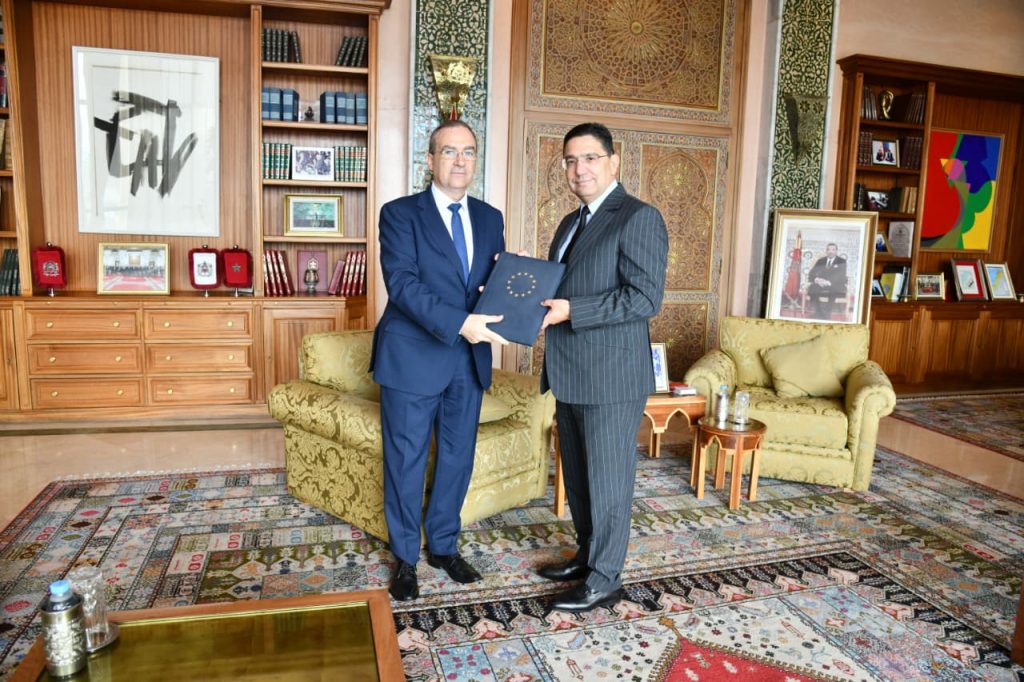
Marrakech – Dimiter Tzantchev, the European Union’s newly appointed Ambassador to Morocco, presented copies of his credentials to Foreign Minister Nasser Bourita in Rabat on Monday.
The ceremony marks a new stage in the reinforcement of the strategic partnership between Morocco and the European Union, set to be further consolidated through political dialogue, economic cooperation, and human exchanges.
Tzantchev succeeds Patricia Llombart Cussac, who held the post from 2021 to 2025 and has now been appointed as the Managing Director for Africa in the European External Action Service (EEAS).
The Bulgarian diplomat’s appointment was announced by EU High Representative Kaja Kallas in late August. Tzantchev comes to Morocco after serving as the EU’s Ambassador to Israel since 2021, bringing with him extensive diplomatic experience in both EU institutions and the Middle East.
A seasoned diplomat
Born in Sofia in 1966, Tzantchev studied Arab studies at Sofia University and later earned a law degree specializing in international law and international relations. This academic background shaped a career that effectively bridges EU institutions and the Middle East region.
Tzantchev comes from a notable family background. His father, Tzantcho Tzantchev, was a renowned director of photography in Bulgarian cinema who created some of the most popular Bulgarian films in the 1960s, 1970s, and 1980s.
As a child, Dimiter appeared in supporting roles in some of his father’s films. He is married to Stanislava Tzantcheva, and they have a son named Konstantin and a daughter named Elena.
He began his professional journey as an editor in the Bulgarian National Radio’s Arabic service, then moved through posts focused on Iraq, the Gulf, and the wider MENA region, including a stint as deputy head of mission in Tel Aviv in the late 1990s.
His diplomatic career continued to develop as he served as Bulgaria’s ambassador to Israel (2008-2010) and then as deputy foreign minister (2010-2012).
From 2012 to 2021, he was Bulgaria’s permanent representative to the European Union, where he became President of COREPER II during Bulgaria’s 2018 EU Council Presidency and later Dean of COREPER II – positions that demonstrate his deep familiarity with the EU’s decision-making processes.
During his tenure as the EU’s envoy in Israel (2021-2025), Tzantchev was a prominent public face of the Union, engaging on sensitive files and public diplomacy, from Holocaust remembrance to combating antisemitism, and representing EU positions amid a highly complex regional context.
These years crystallized his combination of Middle East expertise and Brussels experience – valuable assets he now brings to his posting in Morocco.
For Morocco, Tzantchev’s profile suggests continuity with an EU diplomat who knows both the region and the EU’s internal mechanisms. He arrives as EU-Morocco ties mark 25 years of their Association Agreement and as Brussels remains Morocco’s primary trade and investment partner.
EU-Morocco relations
Morocco-EU relations are among the EU’s most advanced partnerships in the Southern Neighborhood. The legal foundation is the Euro-Mediterranean Association Agreement, signed in 1996 and in force since March 1, 2000, complemented by Morocco’s “Advanced Status” granted in October 2008 to deepen political ties and market integration.
Economically, the EU remains Morocco’s first trading partner: in 2024, total trade in goods reached €60.6 billion (€35.3 billion EU exports to Morocco; €25.3 billion imports from Morocco). Financially, cooperation for 2021-2024 under the NDICI-Global Europe instrument earmarked about €931 million in bilateral EU grants to Morocco.
The Moroccan diaspora represents another vital dimension of this relationship. Moroccans are among the three largest groups of non-EU citizens living in the EU as of January 1, 2024, with significant communities in France, Spain, Italy, Belgium, and the Netherlands.
This diaspora contributes substantially to Morocco’s economy through remittances, with the country ranking among Africa’s top recipients in 2024, receiving approximately $12.9 billion (roughly 8% of GDP), providing an important stabilizer for households and local investment.
Energy and climate have become the new engine of the relationship. In October 2022, the sides launched the EU-Morocco Green Partnership – the EU’s first of its kind – to accelerate work on the energy transition, biodiversity, and green finance.
This aligns with Morocco’s hydrogen strategy and Europe’s plan to import renewable hydrogen and derivatives, with recent initiatives and dialogues in 2024-2025 pointing to green hydrogen and ammonia value chains linking Moroccan renewables to European demand.
The tri-hosted 2030 FIFA World Cup (Morocco-Spain-Portugal) is catalyzing infrastructure upgrades and cross-border planning that naturally intersect with EU finance and standards.
Beyond FIFA’s confirmation of the hosting format, EU-linked finance is stepping up: the European Investment Bank (the EU’s bank) increased Moroccan lending to €500 million in 2024, and continues to support energy grids, transport, and other enablers that will outlast the tournament.
Western Sahara: Morocco’s territorial integrity
The relationship also faces legal challenges related to Western Sahara. On October 4, 2024, the EU’s top court annulled the 2019 farm and fisheries arrangements insofar as they covered Western Sahara “without the consent of its people.”
The fisheries protocol had already lapsed on July 17, 2023, and the EU now lists the Sustainable Fisheries Partnership Agreement with Morocco as “dormant.”
Nevertheless, EU leaders on October 17, 2024, reaffirmed the “high value” they attach to the strategic partnership with Morocco and signaled an intent to maintain strong ties while aligning with EU treaty constraints.
Overall, while the EU institutionally continues to back a UN-led process, a growing number of EU member states now explicitly endorse Morocco’s Autonomy Plan as the most “serious/credible” basis for a settlement.
Spain did so in 2022; France moved decisively in July 2024; and Portugal joined in July. This momentum was evident during Nasser Bourita’s April tour of European capitals, including Paris on April 15, where France reiterated that “autonomy under Moroccan sovereignty” is the framework it supports.
Migration management and security cooperation form another pillar of relations. The EU has financed Moroccan border-management capacities through successive funding under the EUTF and NDICI, alongside broader budget-support programs.
On the ground, Moroccan authorities reported stopping 78,685 attempts to reach EU territory in 2024, reflecting intensive operational coordination with Spain and EU agencies along the Western Mediterranean and Atlantic routes.
Counter-terrorism and security cooperation has intensified between Morocco and European partners. Rabat launched a first high-level strategic dialogue with the UN Office of Counter-Terrorism in September 2024, while the EU now co-chairs the Global Counterterrorism Forum (GCTF) after Morocco’s tenure – keeping Africa and operational cooperation high on the agenda.
On the police side, Europol’s 2024-26 plan explicitly promotes a structured working arrangement with Morocco as part of efforts against terrorism and migrant smuggling.
Looking ahead, the center of gravity in Morocco-EU relations is shifting toward green industry, resilient supply chains, and regulatory alignment – all while both sides manage sensitive issues on trade labeling, fisheries access, and human-rights dialogue.
Tzantchev’s arrival in Rabat comes at a time when both the EU and Morocco are seeking to strengthen their strategic partnership despite challenges, with a focus on mutual interests in trade, energy transition, and regional stability.
[ad_2]
Source link