
[ad_1]
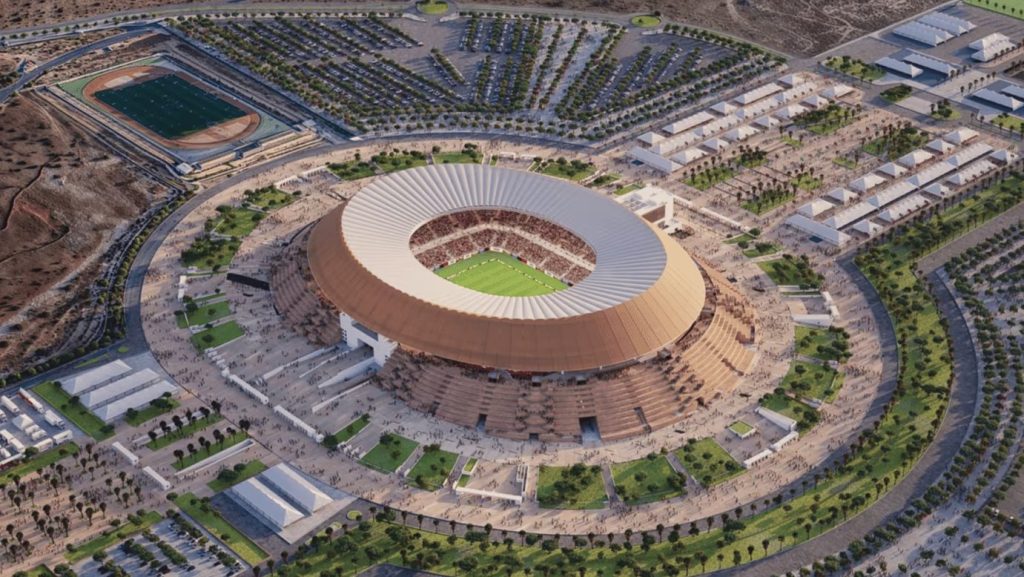
Marrakech – Morocco’s Adrar Stadium, also known as the Grand Stade d’Agadir, is undergoing significant renovations as the country prepares to host the 2025 Africa Cup of Nations (AFCON) and co-host the 2030 FIFA World Cup. The coastal venue, which opened in 2013, is receiving comprehensive upgrades both inside and out.
“The Grand Stade d’Agadir is already prepared to host major events,” assured Hicham Allouli, regional director of the National Company for the Construction and Management of Sports Facilities (SONARGES).
The renovations are being conducted in two phases. The first phase, which is nearly complete, focuses on preparing the stadium for AFCON 2025. “The first phase consisted of exterior improvements to the stadium, which increased parking capacity from 2,600 to 4,100 spaces,” Allouli explained.
The stadium has received extensive updates with an investment of €34 million ($39.5 million) to date. Three training fields and a mini stadium have been constructed outside the main venue.
Security enhancements include facial recognition technology, while additional work has involved strengthening the outer fence, installing new ticketing points, replacing the turf on both the main pitch and training grounds, and renovating the dressing rooms.
The second phase, scheduled for completion by 2030, will expand seating capacity from 41,800 to 46,000 and install a 360° panoramic roof, elevating VIP areas in line with FIFA requirements for Morocco’s co-hosting of the World Cup with Spain and Portugal.
Beyond increasing capacity, these upgrades will strengthen the stadium’s position as an essential venue for international competitions.
Adrar Stadium is one of six Moroccan venues selected to benefit from major investments following the country’s historic semifinal run at the 2022 FIFA World Cup in Qatar. The other host cities include Casablanca, Tangier, Fez, Marrakesh, and the capital Rabat.
Read also: Official: New Rabat Stadium Ready for Morocco Qualifier
Construction of Agadir Stadium originally began in 2003 but faced significant delays after South Africa, rather than Morocco, was selected to host the 2010 World Cup. The project resumed in 2007 with plans to open by the end of 2009, but various setbacks extended the timeline.
The stadium finally opened on October 11, 2013, hosting a match between Morocco’s Hassania Agadir and Algeria’s Kabylie.
Inaugurated in 2013, the Grand Stade d’Agadir covers 32 hectares. It is located 15 minutes from downtown and 30 minutes from the airport.
A related project to enhance the stadium’s surroundings is also underway. Last June, the urban and landscape development around the Grand Stade d’Agadir continued with the launch of public lighting works for a future large urban park. This project, budgeted at 274 million MAD ($27.4 million), will be completed over five months.
The lighting project includes the installation of six remote management systems for intelligent control of the lighting. Two types of lighting units will be installed: 572 type 1 units and 102 type 2 units. The work encompasses execution studies, base construction, installation of solar-powered light fixtures, and maintenance until final acceptance.
The 2030 FIFA World Cup will make history as the first tournament to be held across six countries on three continents. While most matches will take place in Morocco, Spain, and Portugal, one match each will be played in Uruguay, Argentina, and Paraguay to commemorate the 100th anniversary of the inaugural 1930 World Cup.
[ad_2]
Source link