
[ad_1]
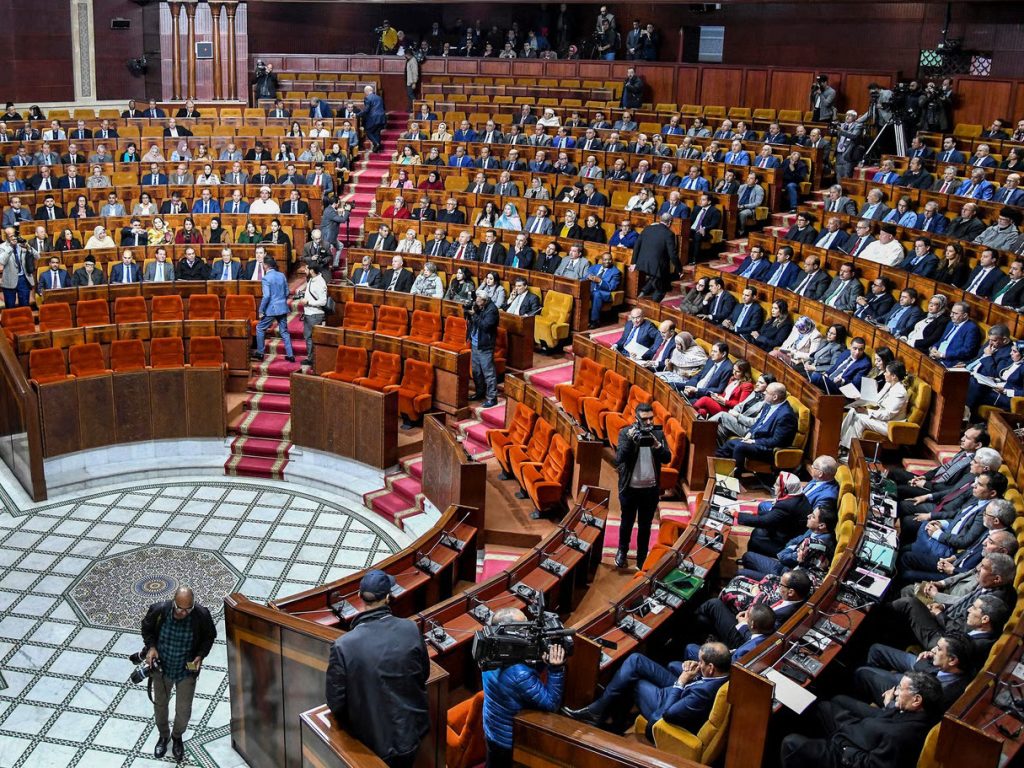
Marrakech – A new report by the Arab Barometer shows that Morocco leads the Middle East and North Africa (MENA) region in support for parliamentary democracy, with 68% of Moroccans favoring this system – significantly higher than other surveyed countries where democratic support has declined over the past decade.
According to the “Political System Preference in the Middle East & North Africa” report authored by Michael Robbins of Princeton University and published this month, Morocco stands out as the country with the strongest preference for a democratic political system in the region.
The report, based on the Arab Barometer’s Wave VIII survey data collected in 2023-2024, found that while support for parliamentary democracy remains relatively high in Morocco, it has experienced a significant decline across most other surveyed countries since the Arab uprisings of 2011.
“In Morocco, there is a clear commitment to a plural system and rejection of a strong ruler,” notes the report. “Morocco’s recent economic growth and improvements to the effectiveness of government may have led to a greater support of a political system of this manner as the most effective way to include citizens in the country’s development.”
The comprehensive study examined preferences for four political systems across seven countries: Morocco, Tunisia, Iraq, Lebanon, Jordan, Mauritania, and Palestine. In addition to parliamentary democracy, the survey measured support for authoritarian strongman rule, governance by Islamic law, and benevolent dictatorship.
Moroccans weigh democracy against tradition and authority
In Morocco, support for parliamentary democracy (68%) far outpaces support for strongman rule (23%), showing a clear preference for democratic institutions. Only Palestine (54%), Mauritania (52%), and Jordan (51%) showed majority support for parliamentary democracy.
This is markedly different from countries like Tunisia, where support for parliamentary democracy has plummeted by 28 percentage points since 2012-2014. Even more striking is Iraq’s 34-point drop over the same period, falling from 73% to just 39%. Today, Lebanon (42%), Iraq (39%), and Tunisia (38%) all register minority support.
“Each of these three countries has engaged in meaningful parliamentary elections over the past decade, but fewer than half in each believe this system is appropriate,” the report states, referring to Lebanon, Iraq, and Tunisia.
The survey also found that only 23% of Moroccans support a system governed by a strong authority that makes decisions without considering electoral results, compared to 46% in Iraq and 36% in Tunisia. “Elsewhere, relatively small minorities believe strongman rule is suitable form of government ranging from 28 percent in Jordan to 20 percent in Lebanon,” the report adds.
Regarding a system governed by Islamic law without political parties or elections, 40% of Moroccans express support – higher than Tunisia (28%) and Lebanon (13%), but lower than Mauritania (58%) and Jordan (57%).
The report notes that in Jordan and Mauritania, “there is widespread support for a system that is both democratic and one that incorporates aspects of traditional Islamic law into the system of governance.”
Perhaps most striking was the increase in support for a “benevolent dictatorship” that provides for citizens’ needs without giving them political rights. In Morocco, this support rose by 26 percentage points since 2016 to reach 39% – the largest increase among all surveyed countries. Jordan saw a 24-point increase, Lebanon a 20-point increase, and Tunisia a 10-point increase.
“By 2023-2024, support was significantly higher across these countries with at least a third in favor of such a system,” the report states.
On the question of whether a country needs a leader who can bend rules to get things done, 47% of Moroccans agreed – significantly lower than the 88% in Iraq, 77% in Tunisia, or 70% in Lebanon.
The report explains that “this attitude underscores the widespread demand for forward progress in countries across MENA, even if it comes at the expense of the legal norms often associated with a democratic system.”
MENA citizens equate democracy with dignity, not elections
The Arab Barometer analysis suggests that across the MENA region, citizens define democracy less by electoral processes and more by outcomes related to dignity (karama).
“In effect, support for democracy is the hope for a broad range of reforms, including guaranteed civil rights; political equality; personal safety; an absence of corruption; and the provision of basic necessities for all to a greater extent than it is about elections,” the report explains.
This understanding differs from textbook definitions of democracy that prioritize free and fair elections. “For MENA publics, the outcomes of the system are more essential for defining the system as democratic compared with the process of inputs,” notes the report.
This paradox helps clarify why many citizens simultaneously express support for democracy while also becoming more open to non-democratic alternatives that might deliver tangible results.
The results also reveal generational differences. In Tunisia, only 31% of young people ages 18-29 support parliamentary democracy – ten points lower than those old enough to have come of age before the 2011 Jasmine Revolution.
The report suggests that “those socialized during the economic challenges that followed the revolution are particularly disinclined toward such a system.”
Interestingly, youth across the region are typically less supportive of strongman rule than older citizens. In Tunisia, citizens ages 18-29 are 12 points less likely to favor authoritarian governance compared to those 30 and older. Similar patterns exist in Iraq (8 points), Mauritania (6 points), and Jordan (5 points).
“These conflicting results suggest that MENA publics are unlikely to advocate for a single system to bring about personal dignity,” concludes the report.
“Frustration with authoritarian systems that failed to provide for the people played a large part in bringing about the protests of the Arab uprisings of 2011. Yet, the democratic experiments in Tunisia and Egypt did not achieve the desired results.”
The report ends with a sobering assessment: “Without a clear vision for the future, it is likely that existing systems will continue to govern while citizens’ ongoing search for ‘democracy’, or really dignity, will continue.”
Read also: Morocco Ranks 107th Globally, 19th in Africa in Democracy Index
[ad_2]
Source link