
[ad_1]
Rabat — Yesterday, on September 23, the 80th session of the United Nations General Assembly (UNGA) opened. Much of its agenda focuses on on resolving Israel’s genocide on Gaza by way of a two-state solution.
Earlier this week, ten nations, including leading members of the UN like France, the United Kingdom, Australia, and Canada, moved a step closer to realizing the two-state solution by recognizing Palestine as a state.
Nevertheless, this solution continues to elude the favor of Israel and the US—both of which have decried attempts to legitimize Palestine and have boycotted meetings focused specifically on such efforts.
The proceedings of the 80th UN General Assembly are expected to elaborate on a previously-established plan which contains concrete steps toward a two-state solution. This plan, which has already received endorsement from the UNGA (but not by Israel or the US), is titled the “New York Declaration.” It calls for an immediate ceasefire, demands that humanitarian aid be permitted to flow into Gaza, and requires that Hamas release all its hostages and completely disarms.
Israeli Prime Minister Benjamin Netanyahu has indicated his desire to instead annex parts of Palestine, including the West Bank. His government has described today’s summit as a “circus” that will “reward terrorism.”
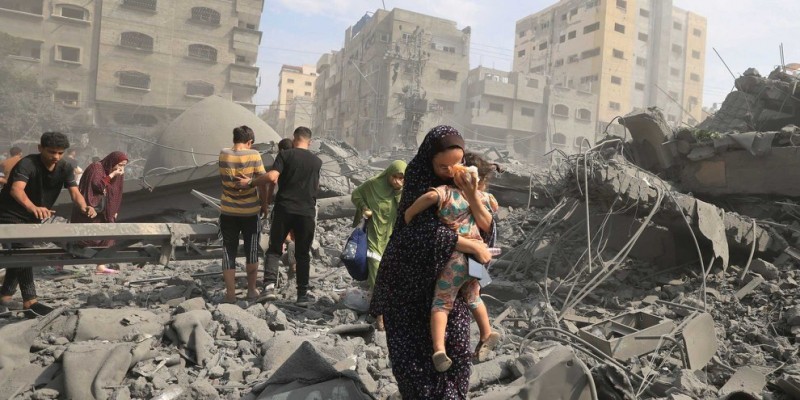
Though Israeli Occupation Forces (IOF) continue to trawl through Gaza City, launching bombs from above and among city streets, this is still the closest in recent years that Palestine has come to formal recognition as a state. This moment therefore marks a desperately critical time for Palestinians—one which could dictate their future as either an independent nation or as the divided, occupied territory that it has been for decades.
The timeline below summarizes Palestine’s history since its inception in the ruins of the Ottoman Empire. Prior to that point, Palestine played host to a variety of peoples and nationalities, including indigenous Palestinians, ancient Egyptians, the Israelites, the Babylonians, the Umayyads, and eventually the Ottomans, who controlled it until the end of World War I.
The British mandate
1916 The Ottoman Empire collapses in the wake of an Allied victory in World War I. Britain assumes governance of the territory of Palestine in what is called the Sykes-Picot Agreement, which divides up control of the Middle East between France and Britain.
1922 The League of Nations, the precursor of the United Nations, charges Great Britain with what is called the British mandate—meaning Britain is asked to administer Palestine. The mandate instructs Britain to establish a “national home for the Jewish people” in Palestine and orders that Jews who move to the territory be granted Palestinian citizenship.
1937 Jewish immigration surges in the years following the British mandate. Arab riots break out in response. A British research commission advises that Palestine be divided into two states: one for Jews and one for Arabs.
1947 As World War II draws to a close, the United Kingdom asks the newly-formed United Nations about a resolution to the struggle between Palestinian Jews and Arabs. This question is particularly important in light of the Holocaust. Many Jews, reeling from genocide, seek their own state. The United Nations adopts Resolution 181, which repeats the British recommendation from a year earlier, calling for a two-state solution. Arab nations unanimously oppose the resolution, viewing it as illegal occupation of their land.
The state of Israel is created
1948 The British mandate comes to a close. Israelis mark their “Independence Day” as May 14, 1948. Disgruntled Arab leaders immediately launch an attack on Israel. Israel goes on to assume control of three-quarters of the Palestinian territory. What follows is the Nakba, or “the catastrophe”: when hundreds of thousands of Arabs flee their homes by force.
1949: The first Israeli-Arab war ends with Jordan assuming control of the West Bank and East Jerusalem and Egypt taking over the Gaza Strip. The United Nations also welcomes Israel into its ranks.
The Palestinian people organize
1964 The Palestinian Liberation Organization (PLO) is founded. The PLO acts as an international representative for Palestinians.
1967 The Six-Day War erupts in response to conflicts between Arab nations and Israel. Israel takes over governance of the West Bank, East Jerusalem, the Gaza Strip, the Sinai Peninsula, and Golan Heights, and begins to permit Jewish settlers into these territories.
1974 UN General Assembly grants the PLO observer status at the United Nations—marking an important step in Palestine’s path to self-determination and international recognition.
1987 Palestinians protest against the occupation in the Gaza Strip and the West Bank in what is called the First Intifada. Unrest ebbs and flows until 1993. Hamas is founded as a Palestinian resistance group and calls for the destruction of Israel. The armed conflict captures the attention of the UN.
Steps towards independence, steps back
1993 PLO leader Yasser Arafat and Israeli Prime Minister Yitzhak Rabin sign the first agreement in a series of negotiations that will be called the Oslo Accords. They create the Palestinian Authority (PA), a governing body which will lay the groundwork for an official Palestinian state, meant to come into being in 1999.
Unfortunately, this state will never materialize. Israeli settlement goes on, Palestinians accuse Israel of bad faith, and the Israeli government grows skeptical of the PA’s desire to curb violence.
2000 The Camp David Summit, which US President Bill Clinton hosts in an effort to expedite negotiations between Israel and Palestine, fails to resolve disagreements over settlements, borders, refugees, and Jerusalem. Talks collapse. The Second Intifada then breaks out in Palestine as a reaction to a right-wing Israeli leader’s visit to Muslim and Jewish sacred sites in Jerusalem.
2005 Israel withdraws its forces from the Gaza Strip following 38 years of occupation.
2007 Hamas assumes control of the Gaza Strip, fracturing the PA’s efforts to establish organized leadership in Palestine.
2012 At the PA’s behest, the UN votes to recognize Palestine as a non-member observer state.
2017 US President Donald Trump recognizes Jerusalem as the capital of Israel and instructs the US embassy to relocate there from Tel Aviv.
2020 Trump mediates the Abraham Accords, which normalizes diplomatic, economic, and security relations between Israel and Bahrain, the UAE, Sudan, and Morocco.
October 7, 2023
2023 Hamas launches an attack on Israel and takes hostages. Israel, led by far-right Prime Minister Benjamin Netanyahu, acts swiftly in retribution and launches a full onslaught on the Gaza Strip. This onslaught will rage for years and will entangle Israel in conflicts with other Middle Eastern nations. Foreign nations, including Qatar, Egypt, and the US, will attempt to mediate, to no avail—both Palestine and Israel continually accuse one another of violating tentative peace proposals.
In time, a mounting stack of evidence points to Israel’s deliberate efforts to extinguish the Palestinian people from Gaza. Human rights groups confirm it as a genocide.
2024 UNGA admits Palestine into the UN as a “permanent observer.” Spain, Ireland, and Norway recognize it as a state. Neither Israel nor Hamas will fully concede to one another’s conditions for peace.
2025 A US-mediated ceasefire goes into effect between Israel and Hamas in January. It is in force for just a few days before being violated by Israel, who accuse Hamas of violating the ceasefire by its manner of hostage release. The ceasefire officially breaks down in March, when Israel launches surprise airstrikes on Gaza.
Throughout 2025, Israeli and Hamas negotiators make stabs at additional ceasefires, but none are successfully implemented.
The UN officially brands the humanitarian catastrophe as a genocide, perpetrated by Israel. Israel is accused of intention to fully occupy and ethnically cleanse Gazans from the strip, ordering forced evacuations to “safe zones.”
French President Emmanuel Macron calls recognition of Palestine as a state “not just a moral duty, but a political necessity.”
He later officially recognizes Palestine as a state. In the space of a few days, so do Portugal, Canada, Australia, the United Kingdom, Andorra, Belgium, Monaco, Malta, and Luxembourg.
The US refuses to do so. Israel, controlled by a government further right than any prior administrations in the country’s history, signals its intentions to occupy the West Bank. The IOF continue to send a ground invasion into Gaza City, furthering their campaign of starvation and genocide with a death toll of 65,00 and counting.
[ad_2]
Source link