
[ad_1]
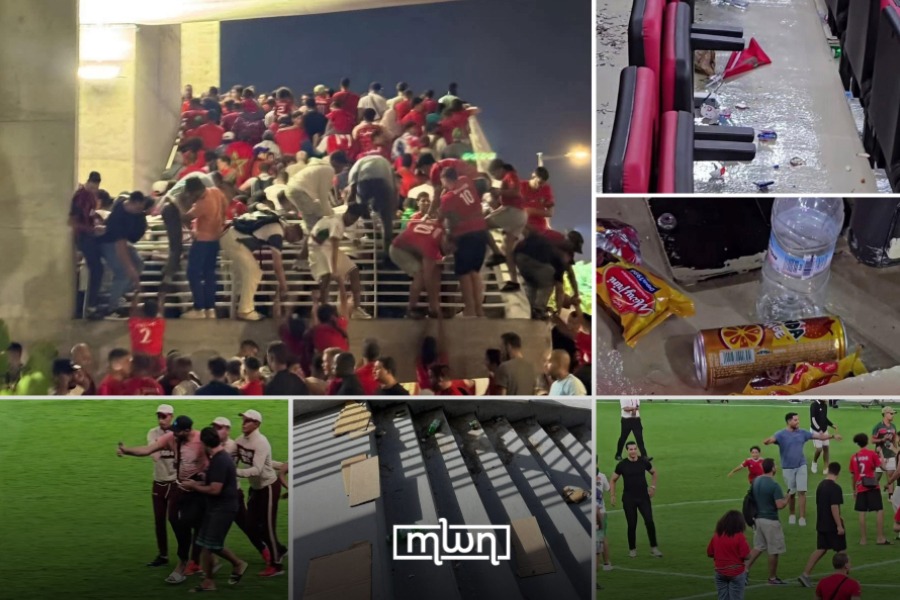
Marrakech – The scenes of chaos, vandalism, and disregard for public property that accompanied the reopening of the Prince Moulay Abdellah Stadium in Rabat did not arrive as a shock – they were, in many ways, painfully predictable. The scenes that unfolded were disheartening, though hardly surprising.
Hundreds of spectators descended onto the pitch as the final whistle blew in Morocco’s match against Niger, with countless smartphone cameras capturing and widely circulating this deplorable moment on social media. The images revealed not only the invasion of the field but also piles of trash left across the stands, and in some cases, crowds exploiting congestion to enter the stadium through unofficial routes.
These were not isolated lapses. Just months earlier, the relaunch of the Mohammed V Stadium in Casablanca witnessed eerily similar disturbances. Go back further, and the same destructive impulses reappear in other corners of Moroccan public life: the smashing of windows on brand-new buses meant to modernize urban transport, or the defacing of newly installed public restrooms meant to improve hygiene standards in cities.
Each episode leaves behind the same gnawing question and forces us to confront it: are Moroccans advancing at the same pace as their infrastructure, or are we building facilities that our collective mindset is not yet ready to sustain? In other words, are our civic habits pacing our infrastructure – or dragging it backward?
The darker reflection that lingers is whether such behavior inadvertently justifies the state’s occasional hesitation to modernize. Why should the government channel billions into jewels of urban design, transport, or sports if those jewels will be so quickly degraded, their luster dulled within weeks by the very citizens they were built to serve?
And the darker corollary is just as clear: when taxpayers treat public “jewels” like disposable trinkets, it almost rationalizes official hesitation to invest again. A stadium may be branded as the crown of Moroccan football, but what does it mean when the public treats that crown as scrap metal or a plaything, stripping it of its shine almost immediately? Why pour concrete if we won’t hold the line on conduct?
Morocco’s decision to concentrate its latest wave of AFCON 2025 infrastructure in Rabat – with at least four stadiums scheduled for completion there – reflects a strategic, if controversial, recalibration of national sporting priorities.
In Rabat alone, the following venues have been confirmed to host Africa Cup of Nations matches: the Prince Moulay Abdellah Stadium (68,000-capacity), the Al Barid Stadium (18,000), the Prince Moulay Abdellah Olympic Annex Stadium (21,000), and the Prince Moulay El Hassan Stadium (22,000).
Meanwhile, Casablanca, despite being the heartland of Moroccan football – home to massive fan bases and storied clubs like Raja and Wydad – will host just Mohammed V Stadium, at a 45,000 capacity, primarily for quarter-final matches.
This has sparked public criticism on multiple fronts. Detractors argue that Casablanca, as the country’s de facto football capital, should have seen far greater investment – not only due to its rich sporting culture, but because its crowds bring unmatched energy and steep heritage to the game.
Instead, the focus on Rabat – where audiences are, in effect, more reserved – appears to some as a choice of civility over passion, of image over identity. The muted atmosphere at the recent Rabat match became emblematic: a polite, cold reception when compared to Casablanca’s fervid, visceral support.
‘A Morocco of two speeds’
In effect, this choice may also be symptomatic of deeper societal divisions. There is an implicit message in the investment: that Rabat, perhaps perceived as more orderly or “educated,” warrants high-end infrastructure. Casablanca – despite its mass enthusiasm and football pedigree – is viewed through a lens of risk, volatility, or even excess.
This tension reflects “a Morocco of two speeds”: one that builds grand venues in controlled settings, and another, vibrant – but less trusted – space where passion outpaces policy.
Yet this is also an opportune moment for reflection: infrastructure must resonate with civic culture, not stand apart from it. Stadiums do not merely host games – they reflect and reinforce the communities that animate them.
Urbanists love to say you invest in minds before marble – institutions before stadiums. Bricks are the easy part. The harder work is the “software” of modernity: civics, enforcement, incentives, culture. Experts have long cautioned that the foundations of true development lie not in steel or concrete, but in the cultivation of civic consciousness. Infrastructure can change skylines; only changed minds can preserve them.
This contradiction is even sharper when one recalls Morocco’s international standing. On the one hand, the national football team ranks 12th in the world according to FIFA – a source of enormous pride and a marker of global recognition. On the other hand, Morocco was ranked 154th out of 218 countries and territories in the 2024 Insider Monkey Global Education Index. The juxtaposition is sobering: we excel on the pitch, but lag desperately in the classroom.
This disparity underscores a deeper imbalance: while we are capable of producing elite performances and gleaming facilities, our social fabric and educational base remain alarmingly fragile. Progress, when built only on infrastructure or spectacle, risks becoming hollow if it is not paired with the deliberate cultivation of human capital, knowledge, and civic discipline.
It is here that the notion of “a Morocco of two speeds” emerges with unsettling clarity. In his 26th Throne Day speech last July, King Mohammed VI explicitly warned that there is no place for such a divided Morocco. And yet, the reality betrays that much-needed royal warning.
‘Tahrgaouite’
On the one side, we see the Morocco of global football rankings, high-speed trains, and glittering stadiums; on the other, the Morocco of failing schools, vandalized buses, and degraded public space. This is not merely a gap in services, but a symbolic fracture – one that sociologists have begun to capture in the increasingly frequent use of a single word: “Tahrgaouite.”
The term, once dismissed as a casual insult, has evolved into a central concept in Moroccan public discourse. Scholars argue that “tahrgaouite” is no longer just a label or passing slang term, but a socio-cultural category – almost a prism – through which exclusion, marginalization, and identity crises are refracted.
It embodies the clash between rural and urban identities, between tradition and modernity, and between inclusion and estrangement from the public sphere. It is, to borrow from Pierre Bourdieu, a site of symbolic struggle within the “social field,” where values, language, and practices are negotiated and hierarchized.
“Tahrgaouite” thrives in the spaces where education fails, where opportunity is scarce, and where the public sphere is felt not as shared property but as a hostile environment.
To dismiss vandalism in a stadium as mere hooliganism is to miss its deeper meaning. Vandalism is, at least to a large extent, the cry of individuals trapped in cycles of exclusion, reproducing inherited patterns of frustration and alienation. It is that deep-seated sense of alienation that transforms into vandalism, aggression, or cynical withdrawal. Tahrgaouite channels that sense of dispossession into action.
To tear a seat from a stadium or break the window of a bus is not simply an act of destruction, but often an act heavy with symbolic resentment: a refusal to recognize public goods as common goods, an assertion of estrangement from a society that has estranged them first.
The individual who tears a seat or smashes the glass of a bus is not only committing an act of destruction but also enacting a symbolic protest – saying: this is not mine, I do not belong here, and if society denies me recognition, I will deny it respect. What looks like mindless aggression is, seen in this light, a distorted demand for belonging, dignity, and acknowledgment.
These gestures, however destructive, are encrypted forms of protest, reminders of the fractures within the collective body. Morocco cannot afford to look away from this diagnosis. A Morocco of two speeds cannot cohere, and no infrastructure, no matter how modern, will survive if built upon a fragile civic foundation.
This “tagraouite” even extends beyond national borders, with holders of Moroccan passports increasingly facing suspicion at airports – not just in Europe where they are often singled out, but even in countries traditionally visa-free like Turkey and Thailand. In the meantime, Chinese and Russian universities that once welcomed Moroccans with ease have now imposed strict, uncompromising admission barriers in response to scandalous past incidents – a trend that risks denying opportunities to many deserving students and further weakening the Moroccan passport’s already fragile standing.
“Tahrgaouite” emerges in the gaps left by failing schools, limited mobility, and persistent inequality. It is passed from generation to generation, a hidden inheritance of marginalization. Some embrace it openly, displaying it as identity and resistance. Others practice it covertly, masking their disconnection under a surface of conformity. In both cases, Tahrgaouite becomes a mirror of Morocco’s deeper malaise: a Morocco of two speeds.
Rwanda: From ruin to renewal
It is tempting in such moments to look reflexively outward to the West, as if Europe or North America offer an eternal manual for progress. Yet, for all the allure of Singapore’s discipline or Scandinavian welfare systems, these comparisons often obscure more than they illuminate.
The West is not a paradise of civic order, nor is it a model easily transplanted into African soil. As such, we don’t need to fly to Singapore for case studies, or rehearse the usual West-is-best tropes. The continent itself has lessons to offer, drawn from histories far darker and recoveries far more unlikely than Morocco’s. Rwanda is perhaps the most striking of these cases – close enough to be useful, and distant enough to be honest.
But the continent itself offers a lesson in how the rebuilding of minds and civic order can precede, and even guarantee, the durability of infrastructure. Rwanda, a country once synonymous with catastrophe, now carries nicknames that testify to its remarkable transformation: “the Singapore of Africa,” “the Switzerland of Africa,” “the cleanest country on the continent,” “the land of a thousand hills,” and increasingly, “the fastest-growing economy in East Africa.”
These titles did not emerge out of thin air or fall from the sky; they are the product of a deliberate national strategy that placed education, civic renewal, and order at the center of reconstruction.
Rwanda’s reality is more compelling than slogans. It was not simply underdeveloped; it was shattered. In 1994, the country collapsed into one of the darkest episodes of the twentieth century, when nearly one million people – mostly Tutsi, but also moderate Hutu – were slaughtered in the span of a hundred days.
The collapse was not merely political, but moral, social, and institutional. It was a vision of hell transposed onto a modern state: neighbors turning on neighbors, churches turned into execution sites, infrastructure collapsing under the weight of hatred and blood. By the end of those months, Rwanda was not just a poor country – it was a graveyard, its social fabric torn and its social contract annihilated.
And yet, from that abyss, Rwanda charted a path of reconstruction that has few parallels in modern history. Where most post-conflict societies sink into cycles of revenge, corruption, and permanent fragility, Rwanda pivoted toward discipline, order, and civic renewal. Under Paul Kagame – while controversial in many respects – the project did not begin with highways or glass towers, but with the re-engineering of habits and the rebuilding of civic identity.
Minds before marble
One of the most emblematic initiatives is “Umuganda,” the monthly day of nationwide community work held on the last Saturday of each month. From 8:00 to 11:00 a.m., citizens repair drainage, sweep streets, plant trees, and mend schools. Participation is not folklore – it is codified in law and enforced in practice. The symbolism is immense: public space is not owned by no one; it is owned by everyone. Kigali’s cleanliness, so often admired abroad, is not cosmetic. It is the lived result of nearly three decades of rehearsed collective upkeep.
Other “homegrown solutions” reinforced this ethos. The “Imihigo” performance contracts require local officials to pledge concrete, measurable targets – whether building roads or improving school attendance – that are later reviewed publicly. Successes are celebrated, failures named. Accountability, so often hollow in governance, became ritualized and visible.
Rwanda also pioneered environmental regulation: in 2008, it outlawed plastic bags, later extending controls to single-use plastics, enforcing discipline at borders, markets, and airports.
Digital governance followed, with platforms like “Irembo” streamlining dozens of state services – making them accessible online, reducing bureaucracy and the friction that often fuels petty corruption, and signaling that the state could be fast, efficient, and findable. Each initiative reinforced the same underlying principle: order is not the byproduct of development; it is its condition.
But Rwanda’s recovery was not only about policies and systems – it was about the reimagining of identity after catastrophe. The “Gacaca” courts, however imperfect, processed nearly two million genocide-related cases, mixing traditional justice with pragmatic necessity to avoid perpetual cycles of revenge.
Campaigns like “Ndi Umunyarwanda” (“I am Rwandan”) sought to dissolve ethnic divisions and reconstruct a shared sense of belonging. Schools, media, and rituals of remembrance were mobilized not simply for education but for civic rebirth. The obsessive concern with punctuality, discipline, and cleanliness was not arbitrary; it was instrumental in forging a new civic culture.
The results have been striking. Kigali is known internationally for its order and safety. Rwanda consistently ranks among Africa’s fastest-growing economies, averaging 7-8% growth for two decades. It hosts major international conferences, turning Kigali into a hub for diplomacy and investment.
The country leads the continent in female political representation, with women holding over 60% of parliamentary seats. Rwanda has also become a pioneer in technology, from deploying drones to deliver medical supplies to advancing digital platforms that cut red tape.
These achievements are not ornamental – they are symbols of a broader wager: that order, identity, and civic renewal must come before, and alongside, infrastructure.
Rwanda’s transformation was not only about policy, but about reimagining the relationship between citizen and state after a historical trauma that left trust in ruins. The genocide was not an ordinary crisis; it was the annihilation of a social contract. To rebuild, Rwanda could not merely reconstruct roads or ministries – it had to reconstruct the very idea of being Rwandan.
Schools, media, and even rituals of remembrance were mobilized to break the logic of ethnic division and elevate a new collective identity. The insistence on monthly community work, the near-obsessive concern with cleanliness, the stress on punctuality and discipline – all these were not arbitrary quirks, but instruments in the broader project of national rebirth.
The lesson is not that Rwanda is perfect; its governance model has clear limits, particularly in terms of political freedoms. Critics point to authoritarian edges, restricted dissent, and heavy reliance on centralized power, with questions lingering about sustainability beyond Kagame.
Yet even with these shadows, Rwanda shows that societies can rise from collapse to coherence when they commit not just to concrete, but to consciousness. It redirected its trajectory from the depths of genocide to a disciplined, orderly, and aspirational society – an achievement extraordinary enough that even its harshest critics cannot deny it.
What outsiders often call Rwanda’s “miracle” – spotless streets, disciplined civic life, rapid GDP growth – is not the result of chance or cosmetic reform. It is the outcome of a deliberate wager: that minds must be developed in lockstep with roads, that schools must be built before stadiums, that habits must precede highways.
Rwanda teaches that progress is not a copy-paste of Western models. It demonstrates that infrastructure without civic renewal is a mirage, while civic renewal without infrastructure is starvation. When the two march together – habits and highways, discipline and development – the result is resilience.
[ad_2]
Source link