
[ad_1]
Positive international law is today in the grip of an unprecedented crisis of legitimacy and effectiveness, a phenomenon highlighted by King Mohammed VI in his speech at the opening of the 82nd session of the Institute of International Law, held in Rabat on August 24, 2025.
The sovereign noted that the international legal edifice is “being strongly challenged by violent headwinds”, a formula that captures the intensity of the tensions tearing apart the declining world order, torn between the imperatives of state sovereignty and the demands of transnational solidarity.
This systemic crisis, the King added, “lays bare the structural flaws and accelerates change”, calling for an urgent reaffirmation of guiding principles and a rethought multilateralism, based on “values, on consensual principles and on institutions that are capable of properly shaping cooperation.”
While this normative storm is shaking the entire international legal order, two areas in particular illustrate this decline: international humanitarian law (IHL) and international trade law. I will devote this article to IHL, the cardinal branch of the law of war and peace, which is now openly mistreated in several theaters of operations.
From Sudan – where civilians are targeted, to the Gaza enclave – which is subject to a blockade and extreme hostilities, to the DRC, Somalia, or the undignified treatment inflicted on refugees and sub-Saharan migrants in Algeria, the fundamental principles of humanitarian law are massively ignored and violated under various pretexts (fight against terrorism, attempted secessionism, intelligence with foreign powers – the case of the Rohingyas in Burma, etc.).
Such a recurrence of serious and unpunished violations has forced the international community to remedy them. Sometimes using force, as is the case with humanitarian interventions under Chapter VII of the UN Charter. These are at center of one of the most sensitive and complex debates in contemporary international relations, because of the tension between the principle of State sovereignty and the moral imperative to protect the human rights of the world against massive human rights violations.
Politicization of Humanitarian Assistance
Humanitarian aid is a system of power, a set of beliefs and practices that shape the way we see others, define what is “normal” and what is not (Antonio De Lauri 2016).
While humanitarian aid is based on three main principles: humanity, neutrality and impartiality, which are supposed to ensure that aid is given to those in need, without favoritism or political influence, the reality is more complicated since humanitarian aid is often influenced by political interests and the strategies and objectives of donor governments. such as national security or counterterrorism, as discussed below, which can undermine its effectiveness and credibility (Andrew P. Ehrenfeld 2021).
The doctrine distinguishes between two types of humanitarianism: the Dunantist model, founded by Henry Dunant, which advocates neutrality, impartiality and independence centered on the urgency of humanitarian action, and the Wilsonian model, which calls for politically engaged action, aiming at long-term changes in societies.
Concrete examples illustrate this politicization: in Afghanistan, aid was used to support military operations; in Nigeria, it is conditional on the fight against Boko Haram; in Haiti, it is geared towards donor-driven development projects. This trend reduces access to vulnerable populations, increases risks for humanitarian workers, and weakens trust in NGOs.
This politicization undermines the credibility of humanitarian actors, blurring the lines between humanitarian missions and geopolitical strategies, and making it difficult to uphold ethical principles in conflict zones. These actors must navigate between operational efficiency and respect for principles, while avoiding being instrumentalized.
In this regard, it is worth referring to the latest report of the Munich Security Conference 2025, which reveals that food is increasingly used as a geopolitical weapon, despite the prohibitions of international law.
This is done through three main methods: the manipulation of food aid, the exploitation of food insecurity for recruitment and retention, and the targeted destruction of agricultural infrastructure. Conflicts such as those in Ukraine, Sudan, and in Gaza illustrate this trend, where hunger is deliberately provoked to weaken populations or influence political dynamics.
The Persistent Tension between Sovereignty and the Imperatives of Respect for Humanitarian Law
The interplay between state sovereignty and the international imperative to alleviate human suffering defines one of the most divisive debates in modern international relations.
The foundation of the international system, as enshrined in the Charter of the United Nations, is the principle of Westphalian state sovereignty – undisputed control over a demarcated territory and its population that conflicts with the peremptory norms of general international law and human rights, as well as International Humanitarian Law (IHL) specifically, which state that certain atrocities (qualified as war crimes or crimes against humanity) are so serious that they require an international response.
This creates a fundamental tension explored both in theory and in state practice:
- The Pluralist Vision: Defends absolute sovereignty and non-intervention (Article 2(4) of the UN Charter), fearing that allowing unilateral interventions would create legal “loopholes” that the great powers could exploit, reminiscent of neo-colonialist practices. This vision is deeply rooted in many post-colonial states.
- The Solidarist Vision: Holds that sovereignty is conditional on a state’s responsibility to protect its citizens. A government that commits massive human rights violations loses its legitimacy and its right to non-interference. The failure of intervention in Rwanda is cited as a monumental moral failure of this principle.
This tension is not only academic; it is the “sovereignty dilemma” that states, particularly in Africa and the Arab world, navigate on a daily basis — both as potential subjects of intervention and as active providers of humanitarian aid.
Is the Right of Humanitarian Interference Outdated and Obsolete?
The post-Cold War 1990s saw military actions explicitly justified on humanitarian grounds (e.g., Kosovo, Somalia). This was classically defined as the use or threat of force without the consent of the State to prevent massive violations of human rights.
The pivotal conceptual change, popularized by the International Commission on Intervention and State Sovereignty 2001 report, which was initiated by Canada, was the shift from “sovereignty as authority” to “sovereignty as responsibility” (R2P). What followed was the “forward-thinking” principle of the Responsibility to Protect (R2P), transforming state sovereignty from an absolute right into a responsibility to protect populations. R2P has been invoked (with mixed success) in contexts such as Libya (2011) or the Rohingya crisis in Myanmar in 2017.
While some cases such as Bosnia and Herzegovina (1995) or Kosovo (1999) have demonstrated that international action can put an end to ethnic iolence and restore a fragile peace, other tragic episodes such as the genocide in Rwanda in 1994 or the Darfur crisis in the 2000s reveal the glaring limits of the multilateral system.
The Emergence of Humanitarian Soft Power in the Arab Regional System
The great powers hesitate, the United Nations is bogged down, but a gleam of hope emerges from the ruins of the crisis of multilateralism, a new form of humanitarian intervention is increasingly taking over, namely “humanitarian diplomacy” which tries to reconcile respect for international law and the sovereignty of States.
The member states of the Arab League and to some extent the OIC (especially Turkiye and Indonesia) are beginning to compete in the field of humanitarian assistance, particularly in favor of Palestine and the Arab states affected by the crises of the Arab Spring.
Typically, estimates of humanitarian contributions have traditionally been based on gross amounts of aid, favoring richer Gulf states to the detriment of disparities in effort relative to economic capacity. However, assessing the true nature of this “generosity” requires going beyond the raw financial figures to understand the effort made.
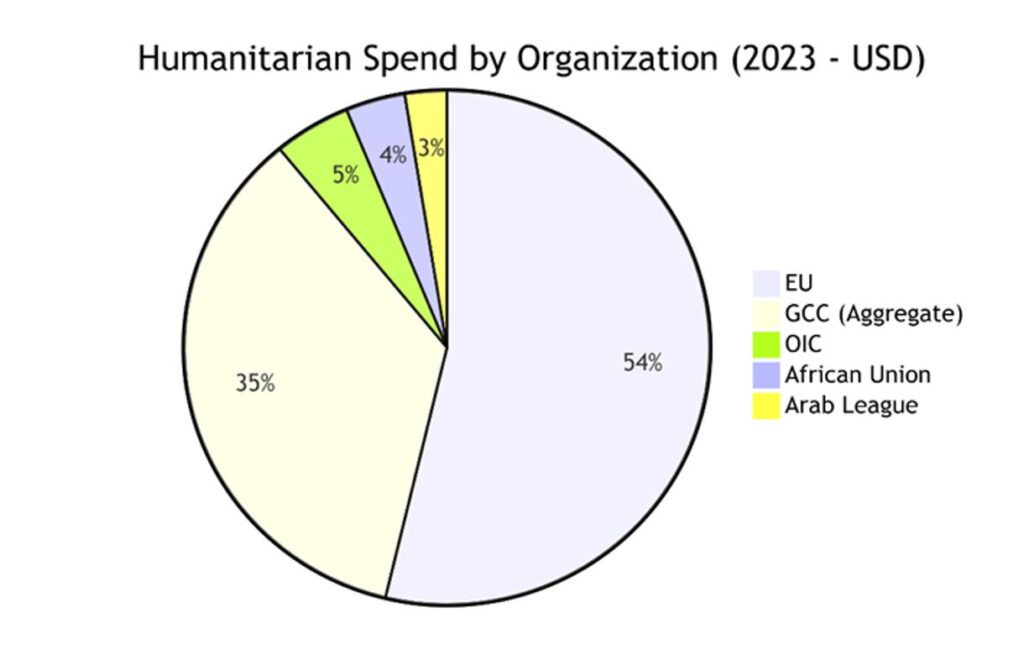
To address this shortcoming, we have conducted an analysis, for the purposes of this paper, that introduces the Humanitarian Aid Effort (HAE) indicator, an equitable measure defined as the amount of humanitarian assistance disbursed per $1,000 to the donor’s GDP, in order to fairly assess donor contributions among the 22 member states of the Arab League.
Using data from OCHA (United Nations Office for the Coordination of Humanitarian Affairs), World Humanitarian Assistance (GHA) reports, the World Bank, and national sources (2000–2023), we built a dataset and analyzed donor trends, with a focus on 2023, a year marked by the worsening crises in Gaza, Sudan and Yemen.
Our analysis reveals a significant dissimilarity between absolute generosity and proportional effort. Although Saudi Arabia and the UAE remain the largest donors in terms of gross amounts, their contributions as a proportion of GDP are quite modest.
On the other hand, Qatar (HAE = 0.800) and Morocco (HAE = 0.429) emerge as the most generous donors in terms of efforts made, with Morocco now occupying third place in the region, overtaking oil-producing countries such as Kuwait Oman.
Qatar’s high level of HAE suggests the use of aid as a tool of soft power and active foreign policy, especially in conflict areas such as Gaza, Syria, Sudan, Somalia and Lebanon.
Besides, data analysis shows that Algeria, despite being an oil-producing country and champion of the Palestinian cause, is at the bottom of the table with the lowest HAE score in the Arab region (0.002), reflecting its ambiguous diplomatic posture that lacks strategic vision. Conversely, states such as Bahrain (HAE = 0.250) and Jordan (HAE = 0.038) show remarkable solidarity despite limited resources.
Arab Humanitarian Solidarity, When Ideology and Political Alignment Take Precedence over Altruism
Do Arab donor states deploy humanitarian resources with the sole motivation of respecting the moral principles of Zakat, charity and solidarity, or as part of a planned strategy of soft power with clear objectives: regional leadership, diplomatic legitimacy and to prevent any hint of influence by rival countries?
In order to comprehend the determinants of aid allocation, we built a robust causal analysis model (R² of 0.78, RMSE 0.92) to identify the explanatory factors of the humanitarian behavior of donor countries by comparing Arab and African countries.
The diagram below illustrates the causal pathway of humanitarian aid from Arab donors:

The analysis reveals that the political alignment of the recipient country with the donor is the strongest predictor of the volume of aid (weight of 0.9), even surpassing the economic capacity of the donor in terms of the level of GDP, on the other hand, geographical distance exerts a moderate negative effect (–0.3), indicating that geographical proximity favors rapid response; It should be noted in passing that Morocco remains an atypical case of analysis (outlier) which sends emergency aid to the affected regions despite their remoteness, as evidenced recently by the air bridges organized between Rabat-Sale and Palestine, on the high instructions of King Mohammed VI.
A comparison of the intervention logics of Arab, African and Western donors reveals an unexpected strategic convergence behind distinct aid modalities; Arab donors, particularly those in the Gulf, favor a model of geopolitical alliance since their aid aims to strengthen strategic partnerships, assert their regional influence and support their allies in conflict contexts such as that of the occupied Palestinian territories (by supporting the Palestinian Authority and /or Hamas) or Sudan (Sudanese Armed Forces or Rapid Support Forces).
The central question then remains: “Is this country of faction an ally or a rival?” This logic is quite similar to Western donors, who, despite a discourse focused on human rights and governance, also use aid as a political lever to promote regional stability and protect their interests.
Furthermore, it should be noted that the few sub-Saharan African donors generally adopt a model of “regional stability” – concentrating their limited efforts on crises in the immediate neighborhood. Their priority is pragmatic: to contain instability among their neighbours to prevent its contagion and the influx of refugees that would threaten their own security.
Conversely, non-Arab African donors take a more pragmatic approach, focusing on regional stability: their limited resources are directed to neighboring crises in order to contain instability and prevent the influx of refugees that could threaten their own security. Thus, despite cultural and operational differences (Western, Arab African contexts), humanitarian aid in these three configurations obeys political patterns in which the solidarity displayed often masks objectives of control, influence or national protection.
In both groups, the humanitarian needs factor was found to be very marginal; the severity of a crisis had little influence on aid decisions, especially among Arab donors where this factor was statistically negligible. Even for African donors, real needs remain secondary to concerns for immediate stability. This systematic decoupling between the allocation of aid and the humanitarian imperative calls into question the ethical effectiveness of the international system of solidarity.
Profiling Arab and African donors
The mapping of donor country profiles, which emerges from the positioning diagram below, reveals the deep logics underlying their humanitarian choices. It shows that aid is never neutral: it reveals strategic priorities, regional identities and political ambitions as we mentioned earlier. Thus, Saudi Arabia and the UAE appear as regional powers using humanitarian aid as an extension of their diplomacy. Their overall volume is impressive, but in relation to the size of their economies, their effort remains quite moderate. Their objective is more about influencing and consolidating alliances, influencing crises and asserting a regional presence.
Conversely, Qatar stands out for its unique profile: it combines strong geopolitical ambition with a very high human effort. In other words, it gives comparatively much more, transforming aid into a central lever of its soft power.
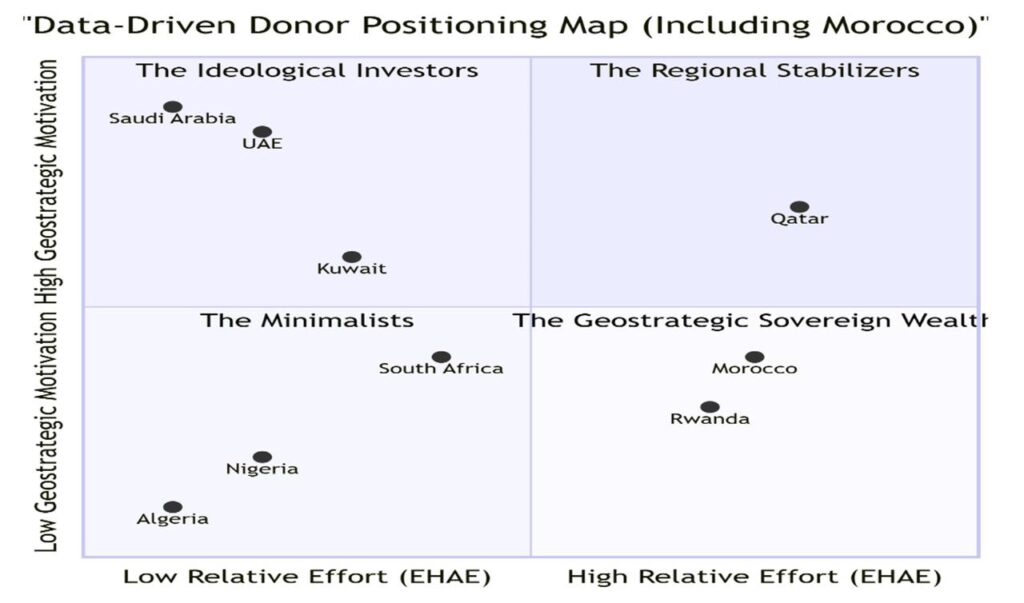
Other states are taking a more targeted approach. Morocco and to some extent Rwanda, although with more limited resources, are making significant humanitarian efforts in relation to their GDP. Their motivation is not to dominate the international scene, at least for Morocco, but to stabilize their regional environment and assert pragmatic leadership.
Morocco, in particular, focuses its action on strong symbolic causes – such as Palestine and Al Quds – and develops targeted partnerships in Africa, building a diplomacy of influence through concrete commitments and field work.
On the other hand, countries such as Algeria, Nigeria and South Africa, despite their economic and diplomatic weight, remain behind. Their humanitarian contribution is small, both in terms of volume and strategic ambition. Algeria embodies this paradox: a state rich in petrodollars but whose aid remains marginal – reactive and not very visible. This is a lack of action which, in itself, says a lot about its priorities oriented towards regional supremacy and attempts to contain Morocco.
King Mohammed VI’s “Niche” Strategic Humanitarian Diplomacy
The analysis based on an indicator called HAE (Humanitarian Aid Effort), which measures aid paid in percentage of GDP, reveals that Morocco differs from the rest of the Arab countries not by the volume of the aid but by the proportional effort it makes. Whereas the UAE or Qatar spend an average of 0.8–1.2% of their GDP on international aid, Morocco spends about 0.4–0.5% of its GDP, which is still relatively high for a middle-income country. Its influence is based less on the volume than on the quality, the targeting approach, symbolism of its impactful humanitarian interventions.
Morocco therefore appears to be an atypical player in the Arab donor landscape: despite limited resources, its relative effort (HAE) is comparatively high. But unlike the Gulf powers, which deploy political influence with a global reach, Rabat focuses its action on two specific registers: Palestine, where it assumes the role of Chairman of the OIC Standing Committee on Al Quds – defying the logic of distance as underlined – and sub-Saharan Africa, where it acts as a “serious and credible partner”.
This dual orientation places Morocco at the crossroads of identified profiles, neither a simple regional stabilizer (like Qatar), nor a universal ideological investor (UAE, Saudi Arabia) but a key player developing intermediate strategies adapted to its capacities.
Further, this positioning gives Morocco a singular credibility, nourished by the coherence of its diplomatic choices (multi-alignment and independent choices); an influence that is based less on the financial scale of its resources than on the quality and credibility of its commitments and intangible assets linked to the charisma and legitimacy of its leadership.
This is not a coincidence; Morocco’s humanitarian diplomacy, led by King Mohammed VI, is distinguished by concrete and balanced action combining active solidarity and strategic mediation in the Israeli-Palestinian conflict.
As Chairman of the OIC Al-Quds standing Committee, the King personally oversees the delivery of humanitarian aid and projects to Jerusalem through the Bayt Mal Al-Quds Asharif Agency (BMAQ), while intervening to break the isolation of Gaza.
The King’s credibility with all sides has enabled him to play a recognized mediating role in the region, as seen in the exceptional land delivery of aid, the reopening of the King Hussein Bridge, and the release of nearly $2 billion in frozen funds to the Palestinian Authority, in line with Morocco’s unwavering support for a just peace grounded in the two-state solution.
Through BMAQ and Mohammed VI Foundation for Solidarity, Morocco has released more than $60 million for Gaza and Palestine (figures of 2023). This is not to mention the efforts made by Morocco to help the victims in various countries such as Syria, Sudan, aid to African countries during the COVID pandemic and other crises.
Humanitarian convoys, field hospitals, resilience projects are all acts that strengthen the legitimacy of King Mohammed VI as a regional leader in Africa and in the Arab and Muslim world.
Bridging the Unbridgeable: Balancing Sovereignty and the Rule of International Law
Putting theoretical, legal, geopolitical and empirical approaches into perspective reveals a profoundly ambivalent landscape; humanitarian action, mobilized as a lever of soft power, appears both as a palliative in the face of the failures of the international order, the decline of international law as well as the reflection of the persistent and unresolved tension between state sovereignty and the protection of human rights.
Rather than seeking a definitive solution to this contradiction, it is more appropriate to explore a middle way, based on a logic of soft intervention – neither brutal interference nor passive neutrality.
In this vein, we venture to suggest some avenues for a better future:
- Investing in prevention, diplomacy and sustainable development in order to address the root causes of conflicts rather than their manifestations alone, and move from the paradigm of management to that of final conflict resolution. This includes putting the two-state solution in Palestine back on track and resolving main frozen conflicts that threat peace and international and regional stability.
- Rethinking sovereignty: Envisioning a graduated and contextualized sovereignty, which reconciles international responsibility and recognition of state specificities, without weakening the legitimacy of states.
- Guaranteeing impartiality and accountability: Imposing common standards on all actors – Western, African, Arab or other – to overcome the logic of double standards applied to few humanitarian actors but not to others.
- Promoting normative change through practice: In a fragmented international order, where the law struggles to impose itself in the absence of an international central authority, norms must be able to be transformed through practice and experimentation (customary law) rather than through a static codification disconnected from realities.
Before concluding, it is useful to recall the reflection of Daniel Warner, who questioned the rigid separation between humanitarian and political issues. According to him, this dichotomy – often based on the idea that politics is compromised by interests, while humanitarianism exemplifies moral purity – is both illusory and counterproductive.
Warner points out that NGOs, in order to gain access to conflict zones, must constantly deal with political authorities. Their action is therefore, in fact, eminently political. By labeling some crises as “purely humanitarian,” states are evading their responsibilities and avoiding engaging in courageous political responses. He thus calls for a lucid repoliticization of humanitarian action: recognizing its political dimension, refocusing NGOs on realistic mandates, and requiring political institutions to confront the roots of conflicts. (Graduate Institute of International Studies in Geneva, Red Cross Journal 1999)
The convergence of legal, geopolitical, and empirical perspectives reveals a profoundly ambivalent landscape. Humanitarian action, often deployed as an instrument of soft power, emerges both as a palliative response to the shortcomings of the international order and as a manifestation of the ongoing, unresolved tension between the principles of state sovereignty and the imperative to protect human rights.
In conclusion, I recall the message of King Mohammed VI in which he emphasizes the need to align tangible fieldwork with sustained diplomatic and political efforts. His message calls for a paradigm shift from merely managing conflicts and palliative responses to actively resolving them through a holistic approach that combines immediate humanitarian action with long-term strategic engagement.
This vision affirms that lasting solutions require more than temporary relief; they require coordinated efforts that address root causes and promote durable peace.
“The Moroccan position is not circumstantial or occasional, nor is it part of sterile political debates or auctions, but stems from a conviction and faith firmly rooted in the conscience of Moroccans, supported by a serious and significant diplomatic effort and concrete field work in favor of the just Palestinian cause and the cause of Al-Quds Al-Sharif.
When we emphasize the conjunction of political action and diplomatic efforts with work on the ground on the field, we believe that efforts must first be focused on improving the daily lives of Palestinians and supporting their resolve in their land, without neglecting to contribute to international initiatives aimed at establishing a just and lasting peace in the region”
(Extract from the Royal Message to the Extraordinary Islamic Summit on Al-Quds Al-Sharif Jakarta on 07/03/2016)
[ad_2]
Source link