
[ad_1]
Rabat — A Moroccan scientist has led a groundbreaking discovery that adds a 29th moon to Uranus.
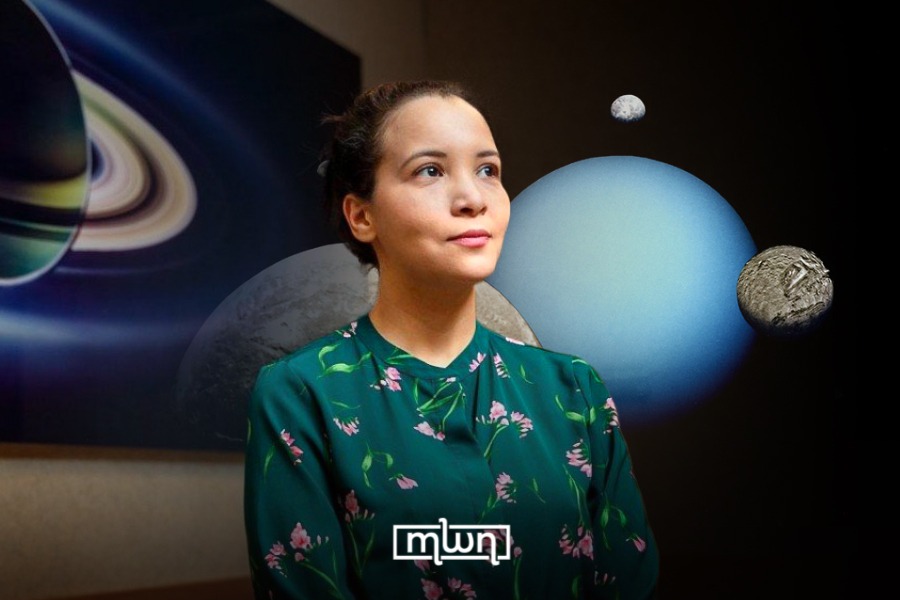
Maryame Al Moutamid, a researcher at the Southwest Research Institute (SwRI), headed the team that spotted the new celestial body using NASA’s James Webb Space Telescope.
The research team made the discovery on February 2, 2025, through a series of ten images captured by the telescope’s Near Infrared Camera (NIRCam). Each image took about 40 minutes to complete.
“Even though this moon is small, its discovery represents a major achievement,” said All Moutamid, who works as a principal researcher in the Solar System Sciences and Exploration Division at the institute’s Boulder, Colorado location.
“This object escaped detection even when Voyager 2 flew past Uranus nearly forty years ago.”
The new moon measures only about 10 kilometers in diameter, which explains why previous spacecraft and telescopes failed to detect it. Its tiny size made it invisible to earlier observation missions.
Scientists classify this moon as part of Uranus’s small and complex inner moon system, where it becomes the 14th member.
These moons orbit alongside the planet’s rings and show a complicated dynamic history that blends moon characteristics with ring system properties.
The moon sits 56,000 kilometers from Uranus’ center in an almost circular orbit between two other moons called Ophelia and Bianca.
Scientists believe it formed in its current position from the beginning rather than migrating there later.
The International Astronomical Union (IAU), the organization responsible for naming celestial bodies, will give the moon an official name after they approve it.
This discovery reflects the advanced capabilities of the James Webb Space Telescope in detecting small objects in our solar system.
It also demonstrates how modern technology continues to reveal new details about planets that scientists thought they understood well.
The find adds to our growing knowledge of Uranus, one of the most mysterious planets in our solar system.
The ice giant planet continues to surprise researchers with its complex moon and ring systems.
Al Moutamid’s leadership in this discovery represents a significant contribution from Moroccan women scientists to international space research, showing the importance of global expertise in modern astronomical discoveries.
[ad_2]
Source link