
[ad_1]
Marrakech – A recent controversy in Meknes has brought attention to questions surrounding Amazigh identity in Morocco. The case involves a family who wanted to name their newborn son “Massinissa,” after the historical Amazigh king, but faced opposition from civil registry officials.
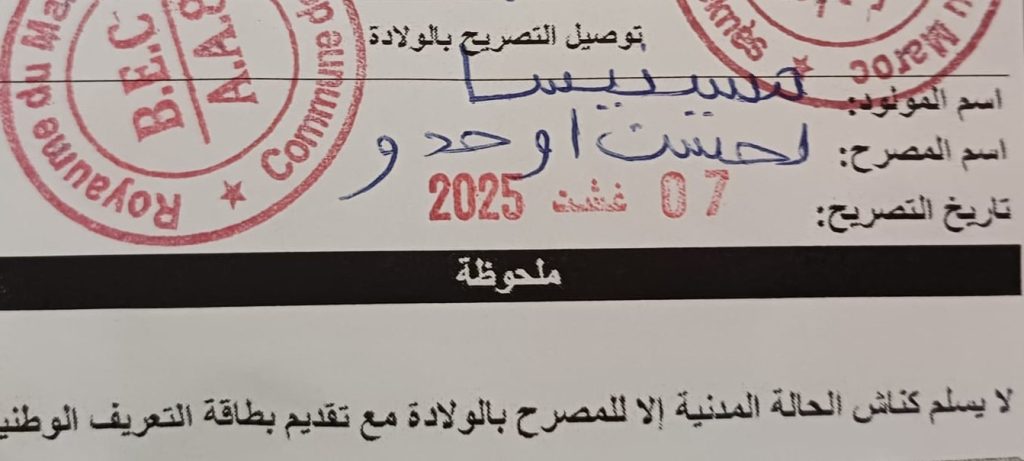
Human rights lawyer Sabri Lhou, who represented the family, explains that the issue began when the child’s father tried to register the name at the eighth district office in the Marjane 2 neighborhood of Meknes. Despite Moroccan laws and ministerial circulars that give parents the right to choose their children’s names, the civil registrar refused to record the name.
Lhou noted that “Massinissa” is an Amazigh name with deep historical importance. The name belongs to the great Amazigh king known for his courage and strength, who famously stated “Africa for Africans.” The lawyer described this refusal as “racial discrimination” and “an affront to dignity,” particularly since no law prohibits the name.
The matter was resolved through direct intervention from the Governor of Meknes Province. In his Facebook post dated August 12, Lhou shared a photo of documents dated August 7, indicating when the resolution occurred.
According to Lhou, the child’s father received a call from the second district services informing him they had reversed their decision, marking the end of the dispute.
This intervention came through “direct instructions from His Majesty’s representative in the province,” which shows respect for the law and citizens’ freedoms, Lhou added.
Lhou expressed gratitude to the Governor of Meknes Province for upholding the law and protecting citizens’ rights. The lawyer stated that this intervention reinforces the principle that “Morocco is a kingdom of immortality, and kings connect the past with the present and future.”
In his social media post, Lhou concluded that restoring the right to name the child “Massinissa” revives the name and its historical character.
New rules on personal names
This incident relates to recent changes in Morocco’s civil registry laws. In July 2023, the government addressed the issue of civil registry officers refusing certain personal names, especially Amazigh names, by transferring decisions on “non-legal” personal names to a higher committee.
Under Decree No. 2.22.04 relating to Law No. 36.21 on civil status, civil registry officers must now accept all declared names, even those that may not comply with naming regulations, while awaiting a decision by the proper committee.
The committee responsible for determining a name’s eligibility for civil registry informs the civil registry officer through the digital system, who then relays this decision to the parent, as outlined in the decree published in the Official Gazette.
Who was Massinissa?
Massinissa, whose name appeared as MSNSN on Libyan steles – likely meaning “their lord” – holds important historical value for Amazigh identity. He became the first king to unite the Amazigh Numidia in North Africa, ruling for fifty years during the 2nd century BCE.
The son of King Gaïa, Massinissa grew into a powerful ruler who proclaimed that “Africa belongs to Africans.” He recovered not only the territories granted to him by treaty with Carthage but also numerous cities and regions under Carthaginian authority.
Massinissa’s accomplishments went beyond military conquest. He developed agriculture extensively through a system of large royal domains capable of producing wheat and vine on a massive scale. Numidia became the “breadbasket” of Rome, Greece, and its islands.
His social and political work matched his military achievements. He settled nomadic Amazighs, united them, and built a strong Numidian state with institutions inspired by Rome and Carthage. He minted national currency, upheld a regular army and navy that he sometimes placed at the service of his Roman allies.
Though a fierce warrior, Massinissa supported literature and arts, sent his children to study in Greece, and welcomed many foreign writers and artists at his court. He was a courageous man who maintained great vigor until an advanced age.
Massinissa gained fame throughout the Mediterranean, with the Greek island of Delos erecting three statues in his honor. His legacy continues as a symbol of Amazigh identity and North African leadership.
[ad_2]
Source link