
[ad_1]
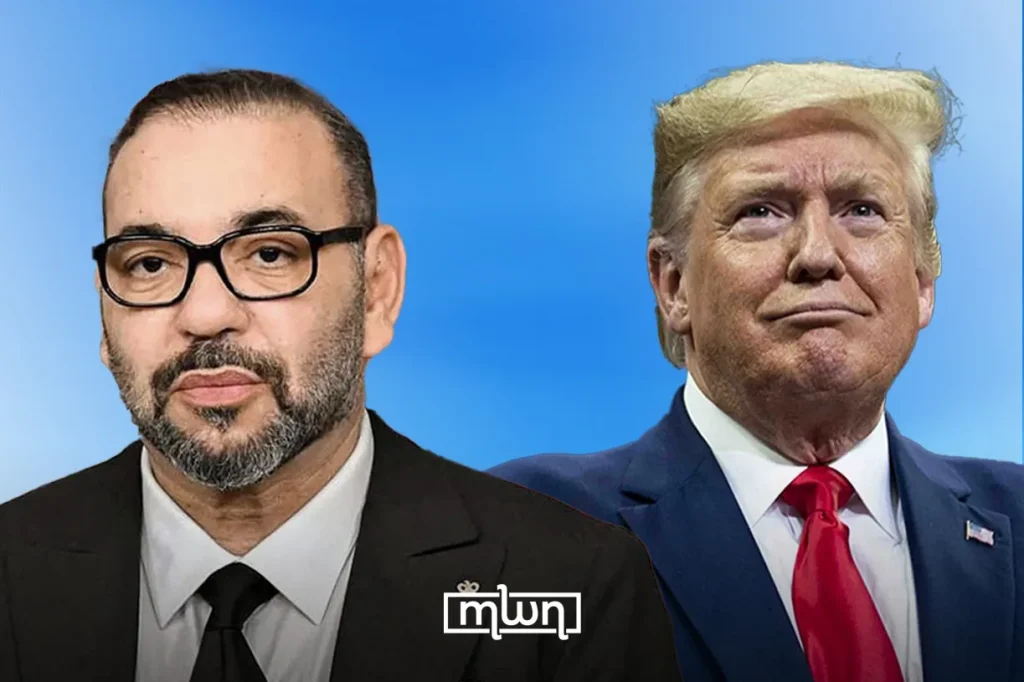
Marrakech – In a blistering message to King Mohammed VI commemorating 26th Throne Day, US President Donald Trump obliterated any remaining illusions about America’s stance on the Western Sahara, ruthlessly crushing Algeria’s desperate maneuvers to keep its failing separatist proxy alive. The letter delivers a fatal blow to the Polisario Front’s already crumbling legitimacy.
“I want to reaffirm that the United States of America recognizes Moroccan sovereignty over the Western Sahara, and supports Morocco’s autonomy proposal, serious, credible and realistic, as the only basis for a just and lasting settlement of this dispute,” Trump declared in his message to the sovereign, shattering any vestige of hope for Algeria’s puppet militia.
The American president pointed to the “strong and lasting partnership” between the two nations, noting their joint work on advancing regional peace and security priorities, including through the Abraham Accords, counterterrorism efforts, and expanded trade cooperation.
“I look forward to continuing our collaboration to promote regional stability, security, and peace,” Trump concluded.
The US president’s latest uncompromising declaration in support of Moroccan territorial integrity torpedoes Algeria’s worn-out narrative and cements America’s recognition of Moroccan sovereignty on the Sahara as an immovable cornerstone of American foreign policy.
This message brutally dismantles decades of Algerian deception and exposes the Polisario Front as nothing more than a Cold War relic sustained by Algiers’ stubborn refusal to accept geopolitical reality.
It also comes as Washington intensifies its stranglehold on Algeria’s dying separatist scheme. Trump’s Africa advisor, Massad Boulos, is already on a critical diplomatic tour of the Maghreb, having visited Tunisia and Algeria, with Morocco set to be the centerpiece of his trip.
The Western Sahara file is no longer a diplomatic sideshow
Behind closed doors, the Western Sahara is now viewed as part of a new Atlantic-African defense system. The ports, submarine cables, energy corridors, and electrical connections passing through Morocco’s southern territories carry massive European and American interests.
Washington has not withdrawn its recognition because the Pentagon sees Dakhla and Laayoune as secured harbors on the Atlantic maritime defense line.
The ongoing high-level Paris meetings between Morocco, the United States, and France marks a defining moment in reshaping the region’s power balance.
Observers say there are strong indications that major powers have abandoned diplomatic pretenses, and Morocco stands on the verge of securing comprehensive recognition of its territorial integrity over the Sahara.
This crushing repositioning follows April’s savage dismantling of Algeria’s position by Secretary of State Marco Rubio. During his meeting with Moroccan Foreign Minister Nasser Bourita, Rubio mercilessly declared that “genuine autonomy under Moroccan sovereignty is the only feasible solution” while vowing to accelerate this inevitable outcome.
The Secretary commanded all parties to “engage in discussions without delay, using Morocco’s Autonomy Proposal as the only framework to negotiate a mutually acceptable solution.” These demands directly assault Algeria’s relentless obstruction of UN-led peace efforts.
The Trump administration has telegraphed an iron determination to terminate the dispute. Washington is actively considering slashing funding for the United Nations Mission for the Referendum in Western Sahara (MINURSO), a mission increasingly seen as complicit in perpetuating Algeria’s regional destabilization project.
In a scathing indictment published last March in the Washington Examiner, Michael Rubin, a senior fellow at the American Enterprise Institute, demanded the United States sever funding for MINURSO, condemning it as a failed entity that “preserves and provokes conflict.”
He branded the Algerian-backed Polisario Front a “Marxist” organization that “holds wives and children as hostages” in the squalid Tindouf camps to prevent Sahrawis from returning to Morocco.
The US is tightening the noose on Algeria
According to a June damning analysis from Spanish think tank Instituto Coordenadas, the White House has weaponized diplomatic measures “to pressure Algiers, including pushing for Polisario disarmament and dismantling the Tindouf camps” to force Algeria to the negotiating table.
Algeria now faces “pressure of unprecedented intensity, which will practically leave it no room for maneuver,” the analysis states. Continued defiance will trigger “devastating consequences: greater diplomatic isolation, legal complications for its support of the movement, and probable secondary sanctions against Algerian entities that maintain links with the Polisario.”
The White House’s most potent weapon involves “the threat of declaring the Polisario Front as a foreign terrorist organization (FTO),” which hangs like a sword over Algiers. A Hudson Institute article presents “detailed legal arguments” proving that “the Polisario Front meets the three legal criteria to be designated as an FTO” under US law.
The Washington Institute for Near East Policy’s recent report “Strategic U.S. Engagement with Algeria” brutally dissects Algeria’s strategic predicament, pointing out the “unprecedented Western alignment behind Morocco’s plan” and “what appears to be an irreversible U.S. position of recognizing Moroccan sovereignty over the territory.”
The report bluntly characterizes Algeria as having “a well-earned reputation for resistance to change” while facing “roiling domestic dissatisfaction” that could force changes in its international partnerships.
The think tank suggests that if Algeria ever returns to rational diplomacy, “Algiers might even conceivably play a role in persuading the Polisario to accept a negotiated model of self-governance, with the Moroccan autonomy plan as the starting framework.” It acknowledges that such a sensible approach remains “unlikely” given the regime’s ideological obstinacy.
Trump is determined to finish what he started
The Western Sahara is no longer a “pending file” at the United Nations but has transformed into a strategic filter separating allies from adversaries. Every country now recognizing Morocco’s sovereignty does so not out of courtesy, but because Morocco has emerged as the linchpin in Mediterranean, Sahel, and African security architecture.
Morocco’s UN Ambassador Omar Hilale proclaimed in April that “the United States is determined to close the Western Sahara file, and we hope to celebrate the final end of this dispute at the 50th anniversary of the Green March with our Algerian neighbors.” The anniversary falls on November 6 – a date that strikes fear in Algiers.
International momentum is building to designate the Polisario Front as a terrorist organization.
Republican Congressman Joe Wilson, alongside Democratic Representative Jimmy Panetta, has submitted a bipartisan bill to the US Congress seeking to classify the Polisario Front as a foreign terrorist group, accusing Algeria and Russia of weaponizing the separatist movement to gain a strategic foothold in Africa.
The legislation, titled the “Polisario Front Terrorist Designation Act,” was formally submitted to the House of Representatives on June 24 and now awaits review by both the Foreign Affairs and Justice Committees.
Algeria has degraded from being a “supporting party” to a political hostage to an illegitimate organization that has lost its revolutionary façade and mutated into a tool of extortion.
Its excessive military spending, coercion of vulnerable African nations, and orchestration of theatrical provocations through the Polisario Front represent desperate attempts to manufacture “incidents” to reverse Morocco’s diplomatic triumphs.
Algeria’s decades-long refusal to permit a proper census of the Tindouf camps reveals its fundamental insecurity about the demographic reality that would collapse its carefully constructed geopolitical fiction.
The regime continues to exploit inflated population figures to maximize international aid – much of which is systematically looted according to the European Anti-Fraud Office’s damning 2015 report.
With Trump’s return to office, the US-Morocco partnership is poised for significant expansion. Expected developments include the establishment of a US consulate in Dakhla, increased American official visits to Western Sahara, the territory’s integration into African Lion military exercises, and the relocation of US-Moroccan strategic dialogue to the southern provinces.
This deepening relationship builds upon historic foundations – Morocco was the first nation to recognize American independence in 1777, establishing what has become the longest unbroken diplomatic relationship in US history.
As both countries prepare to commemorate 250 years of diplomatic relations in 2027, this latest affirmation of support for Morocco’s territorial integrity reinforces a strategic partnership that has withstood the test of time and continues to evolve across multiple domains.
The year 2025, marking the 50th anniversary of the Green March, will likely witness the emergence of a definitive resolution under American auspices – a resolution that will finally dismantle Algeria’s anachronistic regional destabilization project and consign the Polisario Front to the dustbin of history.
Read also: Failed Lobbying and Diplomatic Decline: The Algerian Experience in the US
[ad_2]
Source link