
[ad_1]
Marrakech – The Sahrawi Movement for Peace (MSP), formed by disillusioned former Polisario leaders five years ago, made its historic first appearance before the UN Fourth Committee, presenting an alternative vision for resolving the Western Sahara dispute – rejecting armed struggle and extremism, while embracing dialogue with Morocco and autonomy under Moroccan sovereignty.
“We are not the voice of Polisario, nor Morocco, nor any party or neighboring state in the region. We are Sahrawis tired of war and exile, but also the voice of those who still believe in a future of peace,” declared MSP First Secretary Hach Ahmed Bericalla, who previously served as a minister within the Polisario Front before breaking away to establish this new political organization.
“After more than fifty years, our people have been stuck between confrontation and uncertainty, families separated, youth without prospects, children born under tents, and elders dying far from their land,” Bericalla told the committee, directly challenging the failed policies of the bankrupt Polisario apparatus.
The MSP has explicitly rejected the Polisario’s dogmatism and armed militancy, which they say has trapped Sahrawis in a perpetual state of exile and suffering. “We know that fanaticism and radicalism – like weapons and walls – never bring freedom or prosperity,” Bericalla stated, condemning the Polisario’s rigid ideological stance.
“Each death, each life lost in war or exile is an open wound and a reminder that we have failed,” Bericalla said, “as victims and actors in the conflict, as well as the international community that promised a peaceful solution thirty years ago that was never achieved.”
‘Autonomy Plan as a solid starting point’
Mohamed Cherif, MSP’s Foreign Relations Officer, outlined their concrete proposal for a “special system for the Sahara region” that “fully respects the sovereignty of the Kingdom of Morocco and its national symbols, while guaranteeing Sahrawis a political, legislative, and judicial system consistent with international standards of self-governance.”
Their plan includes “an executive body, an elected parliament, a council of notables, an independent judiciary, and local security forces working in full coordination with the Kingdom’s institutions,” Cherif explained.
“Integrating this special system within the Moroccan constitution, with necessary guarantees, will open the way for historic reconciliation and end a conflict that has lasted nearly half a century,” he added.
The MSP’s proposal comes at a critical time when UN Envoy Staffan de Mistura has called for Morocco to provide more details about its 2007 Autonomy Plan.
In his April 14 speech before the Security Council, de Mistura stated that “self-governance must be ‘serious’” and requested that “the powers delegated to a truly autonomous entity in Western Sahara be clarified,” repeating comments he had also made to the UN’s executive body last October.
Moroccan Foreign Minister Bourita responded firmly on October 21, maintaining that “the Autonomy Initiative is an endpoint, not a starting point” with “its own red lines.”
Cherif noted that the MSP has drawn inspiration from “successful experiences around the world – from Iraqi Kurdistan to Catalonia and the Basque Country,” while viewing Morocco’s Autonomy Initiative – often described as the “third solution” beyond independence or full integration – as “a solid starting point for the solution.”
Polisario’s outdated struggle breeds only despair
During their presentation, MSP representatives directly attacked the Polisario’s failed totalitarianism and exploitation of refugees in Tindouf camps. “It will allow Sahrawis to return to their land, regain their dignity, and actively participate in the development of their region, instead of remaining prisoners of a painful and frozen situation in the Tindouf camps,” Cherif said.
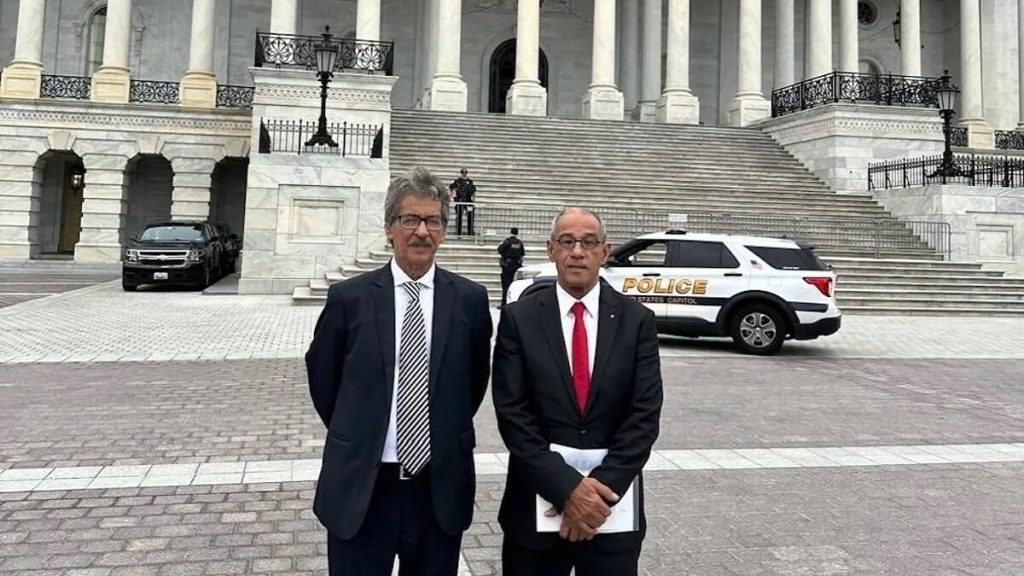
The MSP delegation recently conducted an extensive diplomatic mission in Washington, meeting with members of Congress and Senate from both Democratic and Republican parties, as well as former State Department officials and strategic think tanks.
These meetings occurred just ahead of the UN Security Council’s October session, where MINURSO’s mandate will be reviewed alongside Staffan de Mistura’s report.
American analyst Michael Rubin has described the Polisario as “a vestige of the Cold War” and “an affront to human rights” that Algeria uses “to embezzle humanitarian aid sent to refugee camps.”
He urged the Trump administration and Secretary Rubio to “demand that U.N. Secretary-General António Guterres pay heed to the Sahrawis for Peace Movement and immediately cut off any recognition of the Polisario Front.”
The MSP’s international recognition continues to grow, having recently secured membership in the Socialist International (SI) alongside major social-democratic parties worldwide. Their presence at the UN Fourth Committee has reportedly angered pro-Polisario media outlets, particularly as Bericalla was scheduled to speak immediately after the Polisario representative.
“Our voice is the voice of elders who silently dream of returning before they depart, the voice of young people who refuse to inherit an endless exile, and the voice of mothers who wish to raise their children under the sky of peace and freedom, not under the shadow of a rifle or other instrument of death,” Bericalla told the committee.
“We are many who have decided to put an end to this long and painful journey into the unknown, to close the chapter of confrontation and open the chapter of hope, whatever the sacrifices,” he added, quoting Erasmus of Rotterdam: “Peace, even if imperfect, is always better than a just war.”
The MSP has prepared a draft counter-offer for the UN-led political process to prevent another stalemate in what observers call one of Africa’s longest and least productive peace missions.
“The Sahrawi Movement for Peace is a new, realistic, and constructive partner for the United Nations in its quest to help Sahrawis and Moroccans write a new page of peace and coexistence in the Sahara and throughout Northwest Africa,” Bericalla concluded.
Read also: Exclusive: Sahrawi Movement Says Polisario’s Struggle Is Irrelevant, Doomed to Fail
[ad_2]
Source link