
[ad_1]
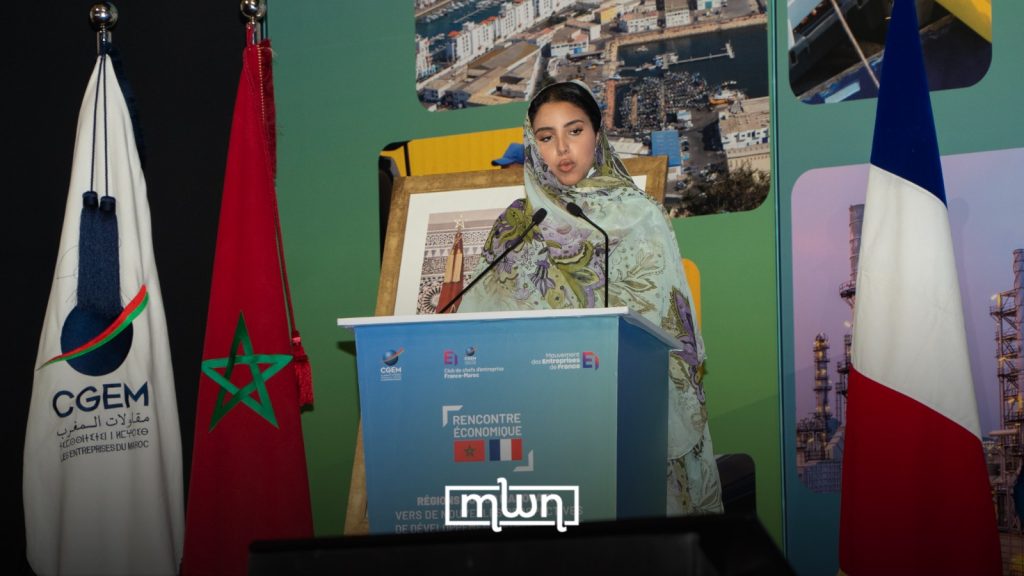
Dakhla — At a high-level economic forum convened today to discuss development opportunities in Morocco’s southern provinces, the President of the CGEM Dakhla-Oued Eddahab Amyra Hormatollah painted a vision of three southern regions transformed into a strategic economic engine poised to reshape the country’s role in continental and international commerce.
Welcoming Moroccan and French economic and institutional partners at the Morocco-France Economic Forum in Dakhla, Hormatollah recalled that “the southern regions constitute today a true sustainable and inclusive lever for national development and African integration.”
The transformation has been made possible through a development model launched by King Mohammed VI in 2015, which has channeled more than 17% of national investments into the region.
The region’s infrastructure has thrived, resulting from this commitment, and has been substantial. Express highways, industrial parks, logistics zones, and energy platforms have reshaped the landscape, with the highly anticipated Atlantic port of Dakhla set to become operational, promising to connect Morocco directly to Europe, West Africa, and the Americas.
A renewable energy powerhouse
The three southern regions—Dakhla-Oued Eddahab, Guelmim-Oued Noun, and Laayoune-Sakia El Hamra—form “a strategic arc of complementarity, an engine of balanced development open to the world,” Hormatollah said.
The Dakhla region particularly stands out for its exceptional energy potential, being home to some of the highest sunshine rates and most powerful winds in the country. The region is positioned to produce competitively priced green energy and is emerging as a key hub for green hydrogen projects.
A massive desalination project, powered by renewable energy sources, is expected to guarantee sustainable water resources for both agriculture and industry — addressing crucial development constraints in an arid region.
Agribusiness and the blue economy
Among the most promising sectors, agribusiness occupies a central place in development plans. Over 5,000 hectares are scheduled for irrigation in the coming months, enabling the development of modern, competitive, and resilient agriculture, the CGEM Dakhla president said.
This agricultural momentum is paired with the valorization of marine products from a coastline that concentrates more than 60% of the country’s national fishing resources.
Marine biotechnology, local transformation, and the creation of conditioning units are opening new pathways toward a blue economy that promises significant job creation and added value.
The integration of these sectors — combining technology and competitiveness — is designed to reinforce Morocco’s food and energy security while maintaining environmental sustainability.
Franco-Moroccan partnership and skills development
Hormatollah recalled the historical depth of Morocco-France relations, saying that “the partnership between Morocco and France is inscribed in a long history of trust and shared ambition.” Building on this foundation, she outlined specific proposals to deepen cooperation between the two countries.
These initiatives include the creation of Franco-Moroccan classes in agro-industry, water management, and green energy; the launch of a skills campus in Dakhla to train youth in tomorrow’s professions; and the adoption of a sustainable partnership charter between Moroccan and French enterprises, particularly in the blue economy and food transformation sectors.
A continental model
Hormatollah’s statement suggests that the forum’s larger ambition extends beyond bilateral relations. She positioned the southern regions as more than simply investment destinations.
“They incarnate a vision of the future — that of an enterprising, resilient Morocco open to its continental and international environment,” she said.
With abundant natural resources, a dynamic youth population, modern infrastructure, and political stability, these regions are “ready to welcome new partnerships bearing growth and sustainable impact.”
She concluded with an invitation to joint action: “By uniting our forces, Morocco and France have today the opportunity to construct a model of economic cooperation that inspires the entire African continent. Let us together make displays of shared prosperity, a decarbonized economy, and inclusive growth serving future generations.”
The forum demonstrated growing confidence that Morocco’s strategic position — both geographically and economically — can catalyze a new model of regional development with implications far beyond national borders.
[ad_2]
Source link