
[ad_1]
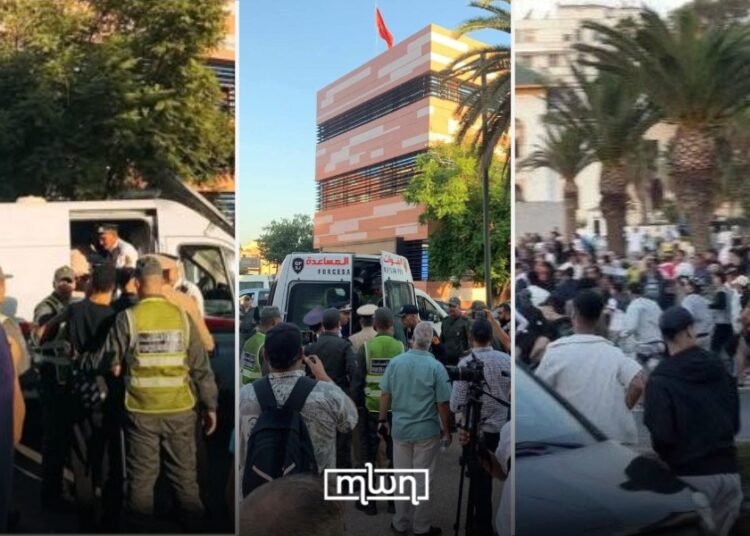
Rabat — Since widespread GenZ212 protests embroiled Morocco at the beginning of last week, hundreds have been arrested. Many of these detainees were arrested while peacefully demonstrating, some of them while making statements to the press.
Authorities have argued that the protests have not been sanctioned, which is true GenZ212 demonstrators have called for the dismissal of the government, starting with its head, Head of Government Aziz Akhannouch, whom the protesters have accused of corruption.
Many protesters detained last week have since been released, though many, if not all, had to reportedly pay for their release and will have to return to court later. Such detainees report harsh treatment after their arrests.
In an exclusive interview, Morocco World News (MWN) spoke to some of these detainees. Here is what they shared:
“They put us in with the criminals, the real criminals,” “Hassan” (pseudonym), a 22-year-old college student, told MWN.
Hassan, who was detained last Sunday during a march in Rabat, shared how violent criminals had shared the same holding cell as him and other detained men. He also described poor conditions in the cells. Police officers taunted detained men and women, using “vile” language and swearing at people in custody.
“We are just peaceful,” said Hassan. “We just want good health, a good education.”
He also clarified that the protests are not against the King, but are directed towards members of the Moroccan Parliament, like Head of Government Akhannouch.
He and other demonstrators, including GenZ212, the protest organizers, have asserted that his and others’ arrests violate Moroccan constitutional rights to assemble and protest without harassment.
Hassan also reported that detained women had been arrested and grabbed by male police officers during the protest—which, when asked, he said is considered taboo in Islam.
“When they got arrested, they [were walking] in the street, peaceful… and they arrested them. They should call female officers, but there [were] male officers,” he said.
According to Moroccan custom, female police officers should interact with female detainees and prisoners, especially in the absence of violent crime.
Hassan says he and his fellow released detainees had to pay MAD 3000, or about $300, to be released. For students like Hassan, this is not an insignificant sum. It also comes with an order to return to court later.
Hassan’s side in the upcoming trial will be complicated by a paper that detainees were reportedly forced to sign by the police prior to their release. This paper contained what Hassan termed false charges, incorrectly ascribing illegal and uncooperative behavior to detainees that would have legally justified their arrest if it was true.
“[The paper said that] we don’t listen to the police, and we fight against the police… They write whatever they want, and they force you to sign. It’s a problem in the tribunal,” he said. “Some of my friends, [the police] beat them because they didn’t want to sign… but [the police] forced them to sign the papers.”
According to Hassan, as of Thursday, some of the arrested still remained in detention.
Also arrested and released last week was 23-year-old “Outman” (pseudonym). He was detained while protesting outside the Palais du Justice, the courthouse in Rabat, where demonstrators were being tried.
He distanced his activism efforts and those of GenZ212 from violent demonstrators, calling the latter a different group, and said that that group was motivated by frustration with the police.
“[The protests] are a pioneering phenomenon. Unfortunately, the state responded with traditional approaches, and that’s a problem,” said Outman. “That’s why it’s important to note that [most of] these young people are aware and know what they’re doing. On… Saturday and Sunday, the young people were very dignified and organized—there was no violence, no vandalism, nothing.”
He said that the protesters had hoped that the state would engage in dialogue, “but instead, there were repression, arrests, and violence.” He referred to an incident in which a group tried to storm a police post in Oujda, where three of the attacking minors were shot and killed by police in self-defense.
He also cited videos online of police assaulting peaceful demonstrators and a police car running over a protester that had blocked its path.
Outman alleged that the authorities approached both violent and peaceful demonstrators with the same “repressive measures,” which he said only generated more anger against the government.
“Now the situation is growing out of control, and we don’t know where it’s heading,” he said. “We need genuine reforms and real democracy, not just superficial changes. And that’s what we’re asking for.”
[ad_2]
Source link